
The Short Answer
Actors memorize lines by attaching each line to the one that comes before it (cue and response), working one scene at a time, and rehearsing out loud, in order. The lines that stick are the ones you try to say before you look. The ones that don't are the ones you keep reading. That's the whole trick, and everything else in this post is detail on how to do it well with forty pages and two weeks.
If you want a tool that runs that exact process, ReciteFlow on Android does it: you paste the script, it splits it into scenes, and every card shows you the previous line and asks for yours. It's free for up to 3 sets and I'll walk through it further down. But first, the method, because the method works with or without an app.
Quick confession before we start. I've stood in a rehearsal room holding a script I had read a dozen times and gone completely blank on my third line. Sounds familiar? I had done a lot of reading and almost no remembering. Those are different activities, and confusing them is the single most common reason people arrive at an off-book rehearsal not off book.
The Method Actors Actually Use
1. Cue and response. Your line doesn't live on its own. It lives attached to the line before it. On stage, nobody hands you a prompt card saying "Line 14". What you get is your scene partner's last words, and your brain has to go from those words to yours. So that's what you practise: hear the cue, say the response. If you learn your lines as a list of things you say, you'll know them at home and lose them on stage.
2. Chunk by scene. Forty pages is not one memorization task. It's eight or ten small ones. A scene has a beginning, a shape and an end, and your brain will hang lines on that shape much more easily than on a page number. Learn scene one until it holds. Then scene two. Then run one and two together. Don't try to hold the whole play in your head on day three.
3. Out loud, in order. Reading silently uses one part of you. Speaking uses your mouth, your breath, your ears. Say the lines the way you'll say them in the show, at roughly performance volume, and always in the order they're performed. The order is not decoration. It is the memory. Each line is a step to the next one.
You don't know a line when you can read it. You know it when the cue arrives and the words come out before you've decided to say them.- Pablo Domínguez
The Part Most People Get Wrong
Now, let's talk about rereading. You open the script, read your scene, and the lines feel familiar. Comfortable, even. That feeling is recognition: your brain confirming it has seen this before. It is not recall, which is producing the words from nothing. Recognition feels like progress because it's pleasant and easy. It's also almost useless for a performance, because on stage there's nothing to recognize. There's a cue and a silence you have to fill.
Here's the honest test: cover your line, read the cue, and try to say your line before you uncover it. If you can't, you didn't know it, no matter how many times you'd read it. I get that this is uncomfortable. Failing in private is the point. Every blank you hit at your kitchen table is a blank you won't hit in the room.
So the practice loop is three steps, and they matter in this order:
- Cover: hide your line, look only at the cue.
- Attempt: say your line out loud. Actually say it. Don't nod and move on.
- Check: reveal the line, compare word for word, and be honest about how it went.
Then spacing. Once a line comes out cleanly, don't drill it ten more times tonight. Let it rest and test it again tomorrow, then in three days, then in a week. The lines you missed are the ones that come back sooner. That's spaced repetition, and it's one of the most solidly established findings about how memory holds. Your time is limited. Spend it on the lines that are actually weak, not the ones that already work.
But here's the trick that flashcard apps miss: a play is a chain. Generic flashcard tools shuffle the deck, because for vocabulary that's exactly right. For a script it's wrong. A randomized deck asks you for line 22 with no line 21 in front of it, so you're learning to produce lines from nowhere, which is a skill you will never use on stage. Worse, it breaks the very link (cue to response) that the performance depends on. Sequential practice keeps that chain intact and spaces the reviews anyway.
How ReciteFlow Handles This on Android
I built ReciteFlow because I wanted the cover-attempt-check loop, with spacing, without breaking the order. It's an Android app (iOS is on the roadmap, no date yet), it works offline with no account and no tracking, and the interface is in English and Spanish. Details are at reciteflow.com. The system inside is called SSRS, a Sequential Spaced Repetition System: lines are learned in performance order, never shuffled, and each one comes back on a schedule that stretches as it gets solid.
Import is a paste. You give the set a title, paste the text, and pick a type. The set in these screenshots happens to be a song (I was learning it that week), so Lyrics is selected. For a play you tap Script instead, and the detection looks for scenes rather than verses. Then you tap Detect structure.
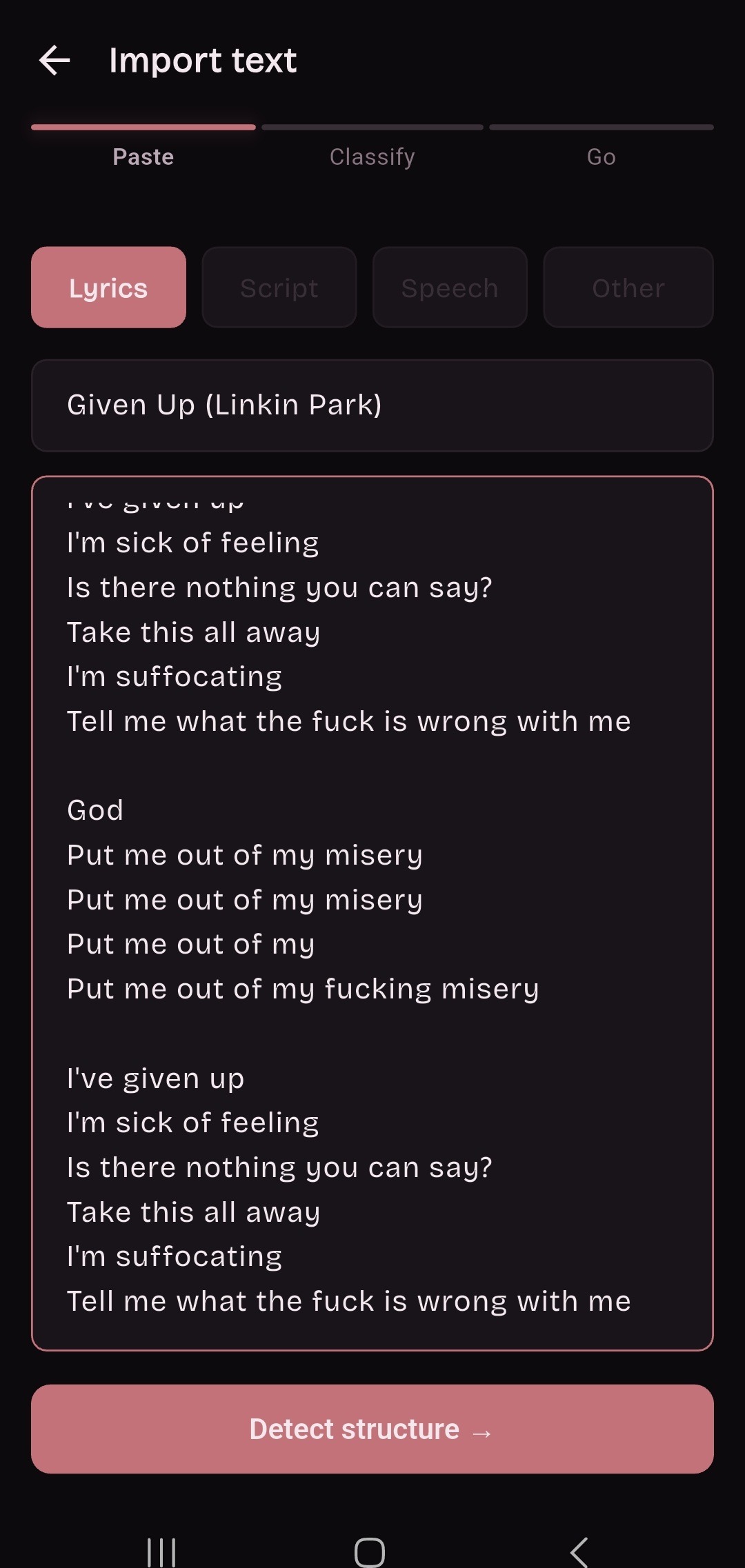
ReciteFlow import screen with pasted text, type selector showing Lyrics, Script, Speech and Other, and a Detect structure button
Once the set exists, the details screen is where you check yourself honestly. In this one the piece is 37 lines, one line has been practised and rated 5/5, the rest sit at 0/5, confidence reads 3%, and the estimate to mastery is about 8 more sessions. That's a fresh set on day one. The card at the top is the performance date: this one is set for Tuesday, March 31, with 51 days left, and the label says SSRS adjusted, meaning the review intervals are compressed so everything is ready by that day, with the weakest lines getting the most attention as it approaches.
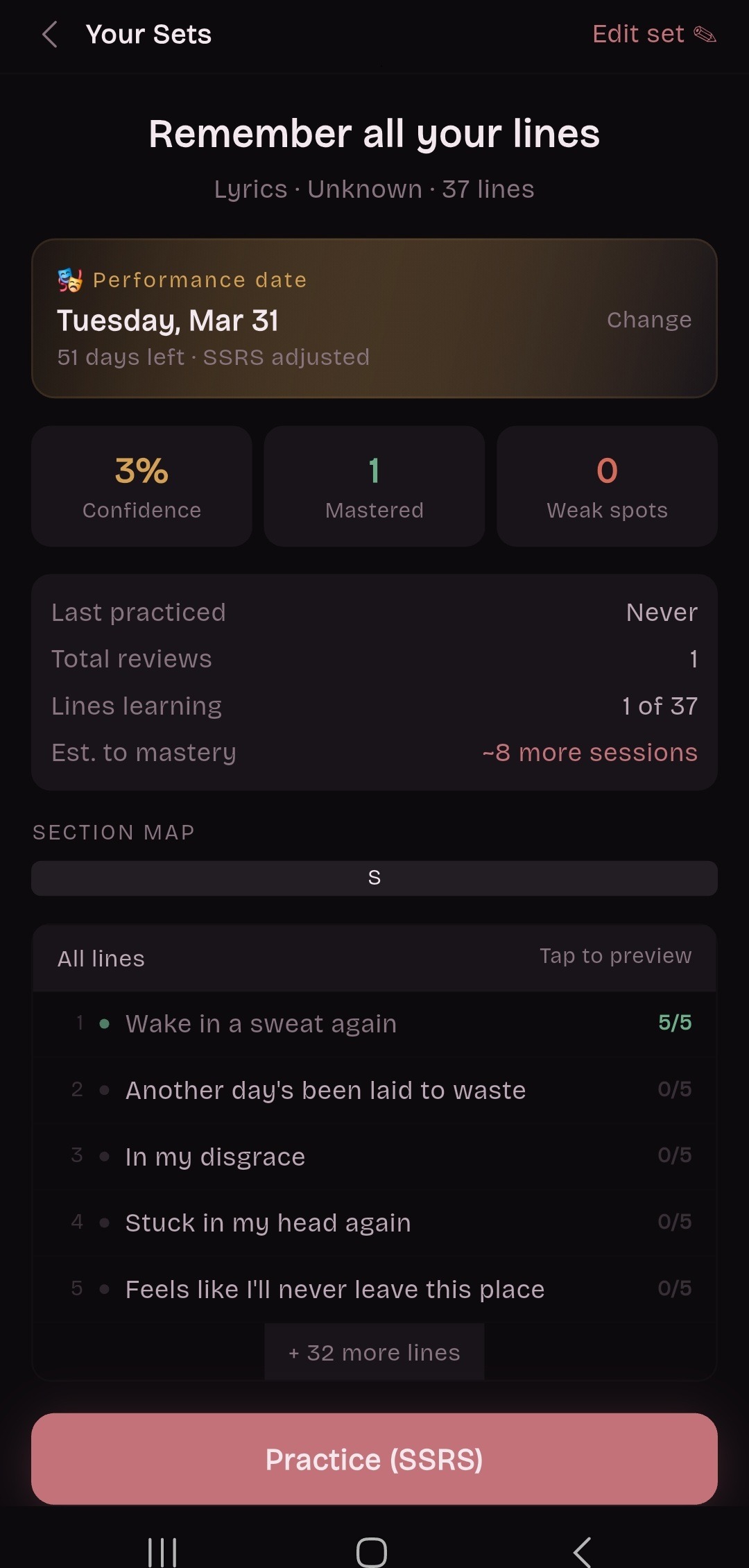
ReciteFlow set details screen showing performance date, confidence percentage, mastered lines, weak spots, estimated sessions to mastery, a section map and the line list with scores
Practice is the loop from earlier, one card at a time. The card shows the previous line as the cue ("Wake in a sweat again", section 1) and blurs the next one under What comes next?. You say your line, tap to reveal, and rate yourself: Blank, Shaky, Close, Solid or Instant. That rating decides when the line comes back. Rate honestly. A generous "Solid" on a line you half-mumbled only postpones the blank to a worse moment.
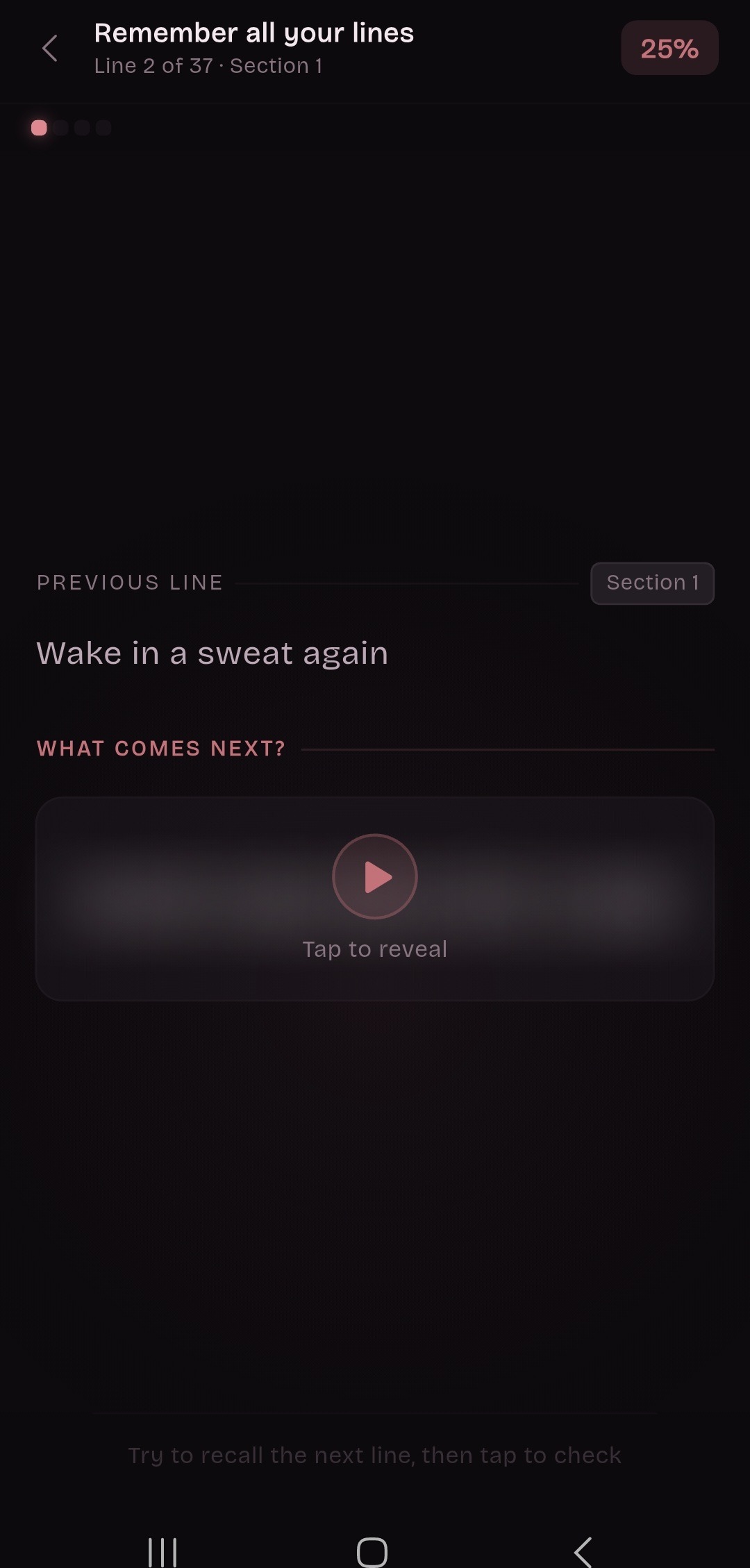
ReciteFlow practice card showing the previous line as a cue and a blurred next line with a tap to reveal prompt
A few things that matter for a cast specifically:
- Repeated material (a refrain, a recurring toast, anything said more than once) is learned once and tested at every place it appears.
- The home screen flags lines dropping below threshold (say, 11 of them) and offers a quick drill of about 2 minutes, which is what you do in the wings or on the bus.
- A run-through mode takes you through the whole piece in order once the scenes hold.
- You can share a set as a .reciteflow file, with or without your progress, so the stage manager can prep the script once and send it to the whole cast.
Quick tip on hint modes. There's an awkward stage between reading a line and recalling it blind, and this is where most people give up and go back to rereading. In Pro, three hint modes bridge it: first letter (you see the initial letter of each word), fill the gap (part of the line is hidden), and full blind (nothing). Move down the ladder as a scene firms up. Don't stay on first letter for a week; it's a bridge, not a destination.
Pricing is simple. Free covers up to 3 sets with the full SSRS, performance deadlines, section detection, and share and export. Pro is $4.99, once, not a subscription, and adds unlimited sets, the hint modes, folders with drag and drop, and a light theme. If you switch phones, restore from Settings with the same Google account.
A Two-Week Off-Book Plan
Forty pages, first off-book rehearsal in fourteen days. Here's how I'd split it. Adjust the scene counts to your script, but keep the shape: learn small, test early, run in order.
- Days 1 to 2: Read the whole play once for story, then mark your lines and note your cues. Split the text by scene. Import it (into ReciteFlow as Script, or into a notebook with cues on the left and lines on the right). Set the performance date to your off-book rehearsal, not opening night, so the schedule aims at the day you actually need it.
- Days 3 to 8: One or two scenes per day, 20 to 30 minutes, out loud, cover-attempt-check every line. Start each session by reviewing what came back due from earlier scenes before adding new material. Expect to rate a lot of lines Blank on first pass. That's normal and it's the point.
- Days 9 to 11: Stop adding. Run scenes in pairs and then in acts, in order. Look at your weak spots list and spend extra passes there. If you're on hint modes, drop to full blind now.
- Days 12 to 13: One full run-through per day, blind, at performance volume, ideally with someone reading the other parts. Fix only what breaks.
- Day 14: A short review of the weakest lines in the morning, then stop. Sleep. Walk in.
Two warnings. First, don't skip days 12 and 13 because the scenes feel fine individually. Transitions between scenes are where memories break, and only a full run finds them. Second, if you're two days from rehearsal and the set details still show a dozen weak spots, that's information, not failure. Drill those dozen. Leave the mastered ones alone.
Questions People Also Ask
How long does it take to memorize a 40-page script?
With daily recall practice (not rereading), most people can be off book in two weeks for a supporting role and need three or four for a lead. The number that matters isn't days, it's honest attempts per line.
Do actors memorize the whole script or just their lines?
Their own lines plus every cue that precedes them. Knowing the story and the other characters' arguments helps enormously, but word-for-word memorization is for your lines and the last few words before each one.
Is it better to memorize lines by reading or by speaking?
Speaking, every time. Reading builds recognition; speaking from a cue builds recall, which is what you use on stage. Read once for meaning, then close the book and talk.
Can I use a regular flashcard app to learn a script?
You can, but shuffled decks break the cue-to-line chain a performance depends on. A sequential tool like ReciteFlow keeps the order and still spaces reviews so weak lines come back sooner.
Is ReciteFlow on iPhone?
Not yet. It's Android only right now, with an iOS version on the roadmap and no release date. On Android it's free for up to 3 sets, Pro is $4.99 once, and the app runs in English or Spanish.

Pablo Dominguez
Full Stack Developer passionate about building interesting projects and learning new skills.