
For about two years I was convinced I sang in tune. Then a friend recorded me at a birthday party, played it back, and I heard a stranger sliding under every long note. Not by a lot. Just enough to make the whole thing sound slightly wrong, and I'd had no idea.
If you're teaching yourself to sing, you've probably had a version of that moment, or you're afraid you're about to. You don't want someone to tell you it sounds fine. You want proof. This post is about how to get it: why your own ears fail you while you're singing, how singers actually drift, a test you can run tonight with nothing but your phone, and how I built the live pitch monitor in Scalita to answer this exact question.
Why you can't trust your ears while you sing
Let's start with a distinction that most beginners never hear: hearing pitch and producing pitch are two separate skills. Plenty of people can tell you instantly that a guitar string is out of tune, then open their mouth and sing a quarter tone flat without noticing. Sounds familiar?
Hearing pitch is a perception job. Producing it is a motor job: your brain has to predict how much tension the vocal folds need for a given note, fire the muscles, and then correct in real time based on what comes back. That feedback loop is where things go wrong, for two reasons.
Reason one: bone conduction. When you sing, roughly half of what you hear doesn't arrive through the air. It travels through your skull directly to your inner ear. That path boosts low frequencies and smears the fine detail your brain needs to judge pitch precisely. It's also why your voice sounds so strange on a recording (that's the version everyone else hears, by the way).
Reason two: memory rewrites what you heard. Your brain knows what note it intended to sing. When you finish a phrase and try to remember whether it was in tune, you're not replaying a tape. You're reconstructing it, and the reconstruction leans hard on the intention. I get that this sounds like an excuse, but it's well documented: singers consistently rate their own live performance as more accurate than a recording of that same performance.
You don't remember what you sang. You remember what you meant to sing.- Pablo Domínguez
Put those two together and you get a singer who is honestly convinced they're on pitch while being audibly off. Not because their ear is bad, but because their ear never got a clean signal in the first place.
This is why a recording is the first honest feedback most self-taught singers ever get. A microphone has no bone conduction and no intention. It just stores what happened. Which brings us to a slightly uncomfortable takeaway: if you've never recorded yourself and listened back critically, you don't actually know whether you sing in tune. You have a feeling about it. Those aren't the same thing.
The two ways singers drift
Now, let's talk about what "off pitch" actually looks like in practice, because it's rarely random. Almost every drift I've seen (in myself and in the recordings people send me) falls into one of two patterns.
Drifting flat on sustained notes. You hit the note fine, hold it, and somewhere around second two or three it starts sinking. This is a support problem. As breath pressure drops, the vocal folds lose the tension they need, and the pitch sags with it. It's the most common drift by far, and it's sneaky because the beginning of the note sounds right, which is the part your memory keeps.
Going sharp when pushing. The opposite problem shows up on high notes, loud notes, or emotional moments. You reach for it, you add effort, and effort in the throat translates to extra tension in the folds. The note lands a little above where it should be. Singers who "power through" a chorus are often sharp on the payoff notes without hearing it, because the adrenaline is doing the same thing to their perception that it's doing to their larynx.
Why does this matter? Because once you know which way you drift, the fix is specific. Flat on long notes means breath work. Sharp on big notes means releasing effort, not adding it. But you can't pick a fix until you've seen the pattern, and you can't see the pattern without evidence.
The no-app test you can run tonight
Before I talk about anything I built, here's the test I wish someone had given me years ago. It needs a phone with a voice recorder and any piano sound: a real keyboard, a free piano website, whatever. It takes five minutes.
- Pick a comfortable starting note in the lower-middle of your range and play it on the piano.
- Start recording. Sing a five-note scale up and back down (do re mi fa sol fa mi re do) on an "ah" or "nee", slowly, about one second per note.
- Stop singing but keep recording. Play each note of the scale on the piano, in the same rhythm, right after.
- Stop recording. Wait at least an hour. Seriously, wait. Your memory of what you sang needs to fade.
- Listen back with headphones and compare your notes to the piano notes, one by one.
What you're listening for is direction, not perfection. Did the top note land under the piano? Did the last "do" sag before you cut it off? Did you overshoot going up? Write down what you hear. That note is worth more than a month of practising without it.
Quick tip: hum the piano note back to yourself after each of your recorded notes. If you find yourself adjusting up or down to match, that's the gap. Your ear can hear it even when your voice couldn't produce it.
The limitation of this test is obvious once you've done it a few times: you only find out afterwards. You can't correct mid-note, and comparing by ear gets tedious fast. That's the problem I wanted to solve.
What the live pitch monitor shows you
Scalita is the Android app I built around scales and exercises, and the live pitch monitor is the part that answers the question in this post's title. Put your earphones on so the phone hears only you, start any exercise, and a real sampled piano plays the notes while a trail draws where your voice actually lands against them.
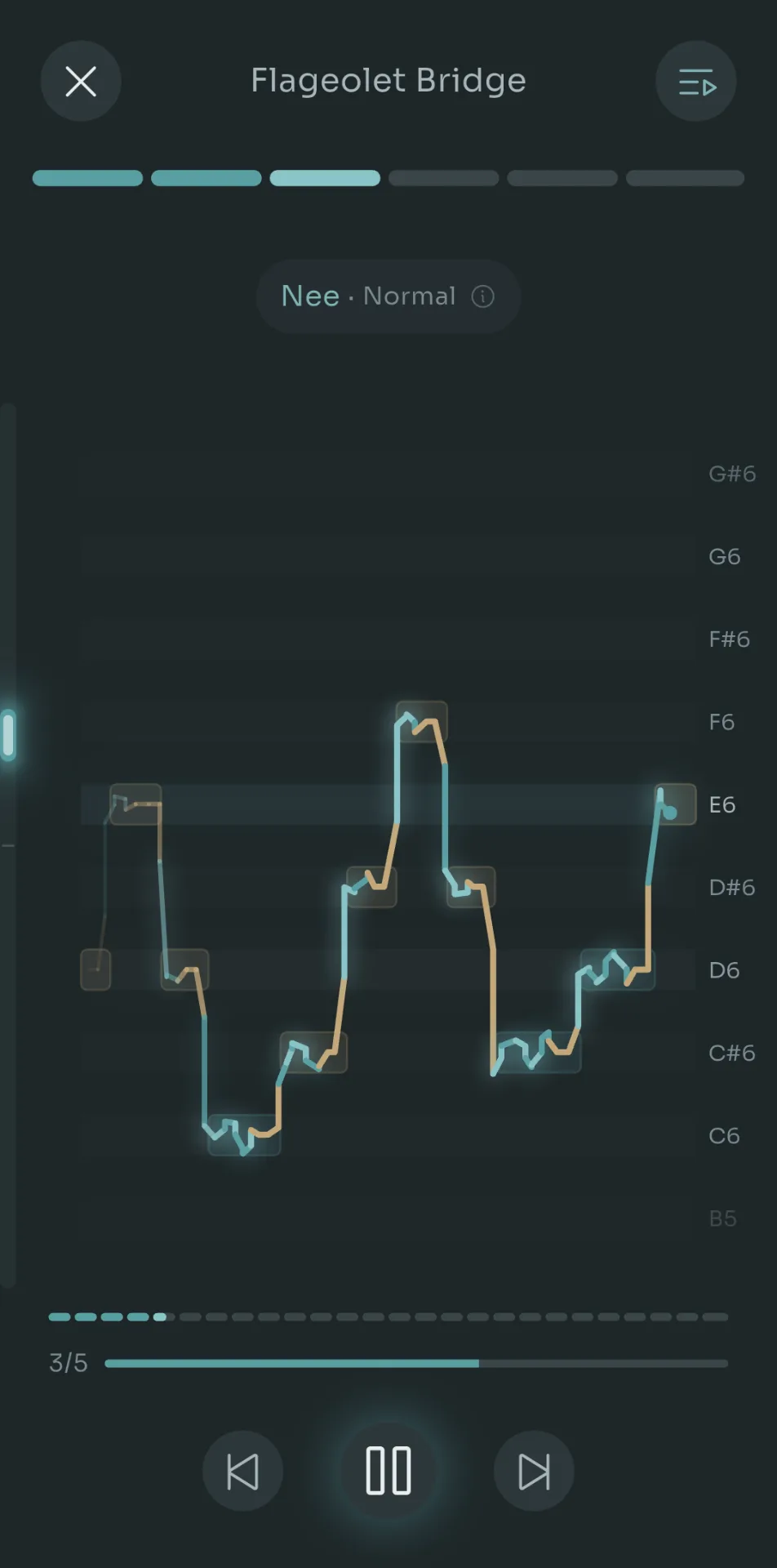
Scalita live pitch monitor during a scale exercise, showing a voice trail moving between highlighted target notes from C6 to F6
Here's how to read that screenshot. The highlighted boxes on the grid are the notes the piano is playing. The line is the singer. Where the trail is green, the voice is sitting on the target. Where it turns amber, the voice is drifting away from it. Look at the transitions between notes: that's where the amber shows up most, which is exactly what you'd expect from a voice sliding into the next pitch rather than landing on it.
Now compare that to the two drift patterns from earlier. A note that starts green and fades amber downward is the sagging-support drift. A trail that shoots above the box on the high notes is the pushing-sharp drift. You see it while it's happening, which means you can adjust while it's happening. That's the loop your bone conduction was breaking.
But here's the trick: staring at a line all the time is its own problem. It pulls you out of your body and into your eyes, and singing is not a visual skill. So the monitor can be turned off, and the same player just shows you the note you're meant to be on.
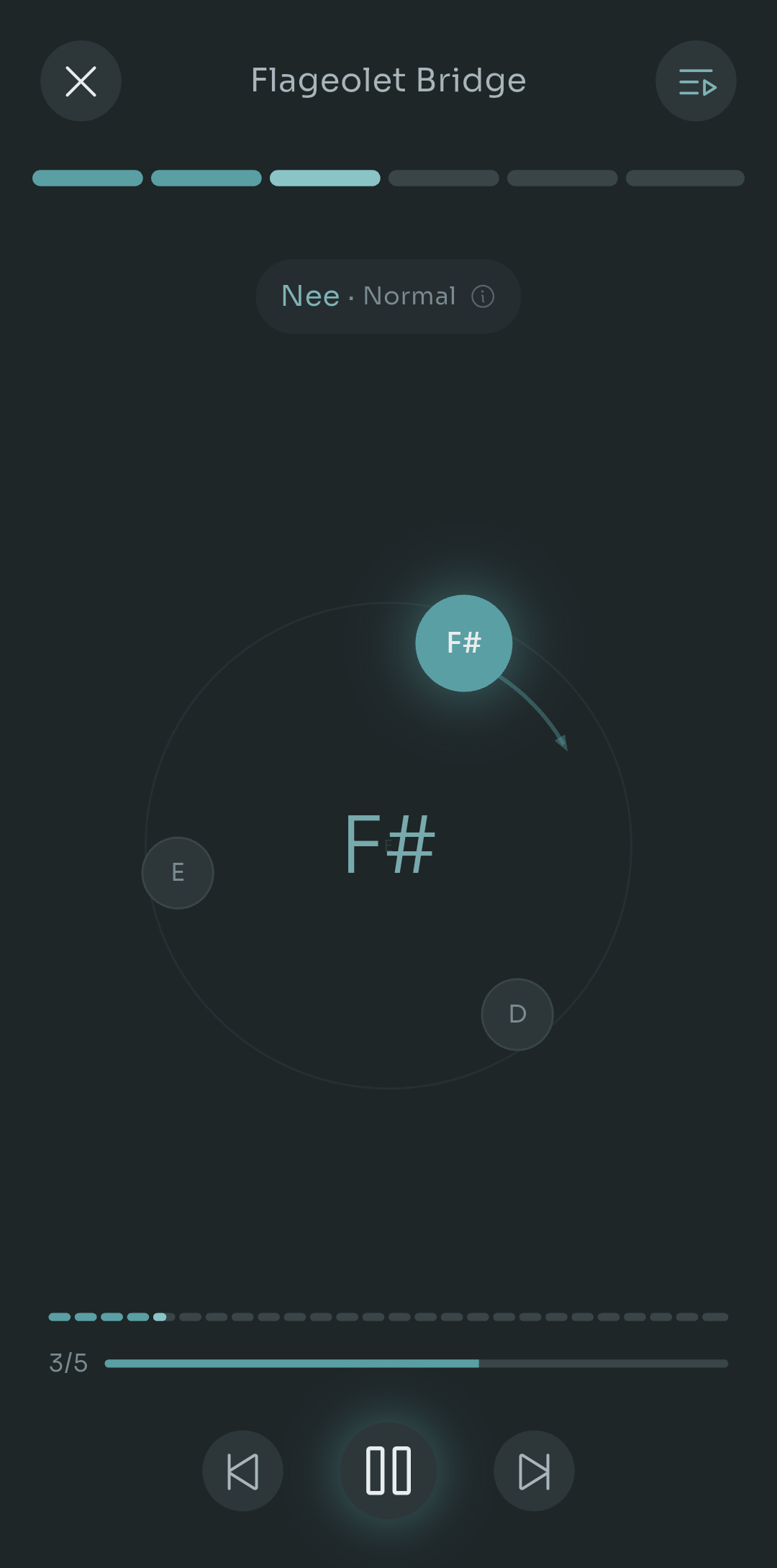
Scalita exercise player with the pitch monitor turned off, showing only the current note F# on a circular dial with the neighbouring notes E and D
My suggestion is to alternate. Run the exercise once with the monitor on to find out where you drift, once with it off to practise trusting the feel, then once more with it on to check whether the feel was right. Three passes, and you've turned a vague suspicion into a specific, checkable habit.
Pitch targeting: one note at a time
Scales are great, but sometimes you need to isolate a single note. Pitch targeting does that. Tap any key on the keyboard, hear the piano play it (it loops if you want), sing it back, and the trail on the left shows you where your voice actually sits relative to that one note.
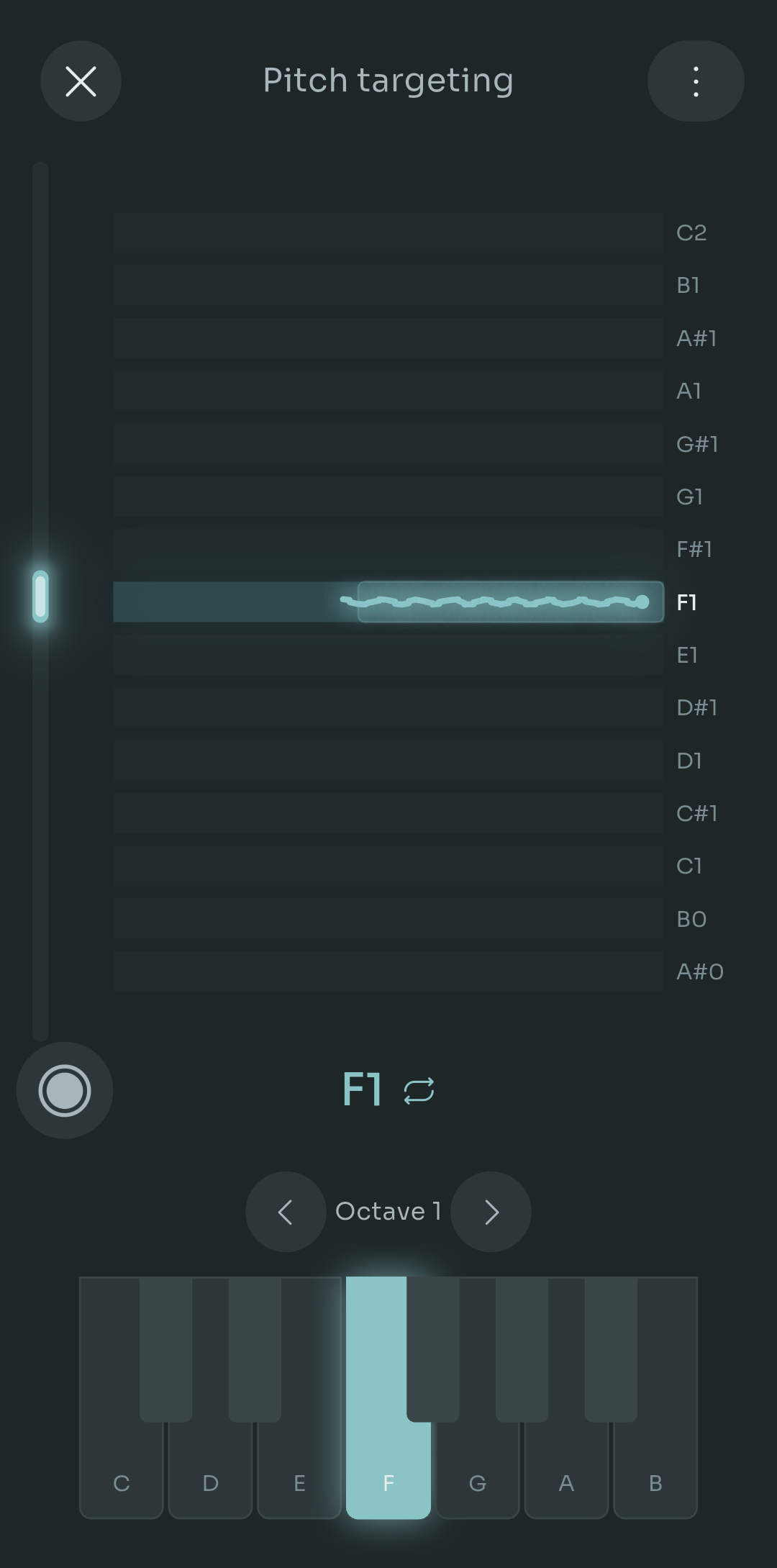
Scalita pitch targeting screen with F1 selected on the keyboard and a wavy voice trail holding steady on the F1 line
In that screenshot the target is F1 (a very low note, this was a bass singer testing the bottom of their range), and the trail is holding on the line with a gentle wobble. That wobble is normal vibrato-ish movement. What you don't want to see is the trail sinking below the line as the note goes on, or hovering half a row above it.
The record button at the bottom left is the piece that connects back to the no-app test. Hit it, sing your note or your scale, and you get a practice take you can play back immediately: what you actually sang, not what you remember singing. Takes stay on your phone, so next week you can pull up the same target and compare. "After 3 weeks the top note stopped sagging" is a sentence you can only say when you've kept the evidence.
To be completely clear about what costs what: the live pitch monitor and pitch targeting itself are free. The practice recorder inside pitch targeting is the one Pro feature in this area. Pro is a single payment of $4.99, not a subscription. The app is Android only for now, and it runs in five languages.
A five-minute daily pitch routine
Knowing you drift is step one. Fixing it is boring, daily, and short. This is the routine I actually do, and it works with the app or with the no-app method from earlier. Five minutes, no more.
- One sustained note at the bottom of your range. Hold it for a slow count of eight. Watch (or listen) for the sag in the second half.
- One sustained note in the middle of your range. Same count. This is your reference: it should be the easiest one to hold steady.
- One sustained note near the top of your range. Same count. Watch for the overshoot on the attack and the tension creeping in.
- One five-note scale up and down, slowly, about one second per note. Land each note, don't slide into it.
- Listen to the take. Note one thing that drifted and which direction. That's tomorrow's focus.
Why sustained notes at three points in the range? Because the two drift patterns live in different places. The bottom and middle expose the flat-on-hold problem; the top exposes the sharp-when-pushing problem. Checking all three every day means neither one hides for long.
Quick tip: keep the volume moderate. Most drift gets worse at high volume, and you'll learn faster fixing it at a level where you can actually feel what your breath is doing.
Don't get me wrong, five minutes a day won't turn you into a studio singer. But it will do something more useful for someone in your position: it replaces the suspicion with a number. After a month you'll be able to say "I used to go flat on notes over four seconds, now I hold to eight." That's proof. That's what you came here for.
Where to go from here
Let me pull the whole thing together. You can't judge your own pitch while singing because bone conduction muddies what you hear and memory tidies up what you remember. Recordings fix that. Drift is usually one of two things: flat as support fades on long notes, or sharp as effort spikes on big ones. And the fix is short, daily, and evidence-based.
Your next steps, in order:
- Run the no-app scale test tonight and wait an hour before you listen.
- Write down which direction you drifted and where in the range.
- Start the five-minute routine tomorrow, with or without the app.
- If you're on Android, try the live pitch monitor for the real-time version of the same feedback.
And if you do the test and discover something you didn't expect (sharp when you were sure you were flat, or perfectly fine when you were sure you weren't), I'd genuinely like to hear about it. Leave a comment or send me the take. Nothing has taught me more about pitch than listening to other self-taught singers find out what they actually sound like.

Pablo Dominguez
Full Stack Developer passionate about building interesting projects and learning new skills.