
Short answer: learn the song in the order you'll sing it, one line cueing the next, and review each line on a schedule instead of on repeat. Lines you nail come back less often. Lines you fumble come back tomorrow. Stop running the whole song top to bottom, and stop practicing the day you first get through it clean. That's the method. Everything below is the how.
If you want something that runs that method for you, ReciteFlow is an Android app that does exactly this (full disclosure: I built it, because I kept showing up to rehearsals with the third verse still on paper). You paste the lyrics, it splits them into verses and choruses, and your first session is a few minutes of previous line, next line, reveal, rate. It's free for up to 3 sets, Pro is $4.99 once, and right now it's Android only, with iOS on the roadmap. More on that later. First, let's talk about why your current approach isn't working.
The two things singers get wrong
Picture the situation. It's Wednesday. The gig is Saturday. You've got three songs on the set list that you can sing along to but can't sing alone. Sounds familiar?
Here's what most of us do: we put the track on, sing it top to bottom with the lyrics in front of us, and repeat until it feels okay. Then we do it again the next night. And here's what actually happens in your head during that process.
Mistake one: you train the first verse and abandon the third. Every full run-through gives verse one a fresh repetition. By the time you reach the bridge, your attention has drifted, you're half reading, and the last verse gets the weakest version of you. Ten run-throughs later, verse one is bulletproof and verse three is still a guess. You've spent most of your practice time on the part you already knew.
Mistake two: you stop the day you can get through it once. You finally sing it clean without looking, you feel great, you close the laptop. Next rehearsal, half of it is gone. That's not a bad memory, that's how memory works. A single clean pass proves the line is available today, not that it'll be there in 72 hours under stage lights with a drummer counting you in.
Two mistakes, two fixes. Let's take them in order.
Fix one: learn in order, one line cueing the next
Think about what actually happens on stage. You never need to recall line 14 out of nowhere. You need to recall line 14 right after singing line 13. The previous line is your cue. The melody, the breath, the last word you just sang: all of that is pulling the next line forward.
So that's how you should practice it. Not as a block of text to stare at, but as a chain of pairs. Cover the page. Say (or sing) the line you know. Try to produce the next one from memory. Check. Move on.
This is the same thing flashcard apps do, with one crucial difference: you never shuffle. A randomized deck would ask you for line 22 cold, then line 3, then line 17. That trains a skill you'll never use. Songs are sequential, so the learning has to be sequential too. The cue for every line is the line before it, and that's the only cue you should practice with.
Now, let's talk about the part everybody skips: work in sections, not in songs. A song is really 6 to 10 chunks (verse 1, chorus, verse 2, chorus, bridge, and so on). Learn verse 1 as a chain until every line cues the next. Then verse 2. Then link them. You'll notice something immediately: the third verse gets the same quality of attention as the first, because you're not exhausted from singing your way down to it every time.
Quick tip: the hard joins are usually between sections, not inside them. The end of a chorus into the start of verse 2 is where you'll blank on stage. When you drill, make sure the last line of one section is cueing the first line of the next, not just lines inside the same section.
Fix two: space the reviews, and learn the chorus once
Here's the trick that fixes the "gone by next rehearsal" problem: don't review everything equally. Rate each line as you go. If a line came out instantly, you don't need to see it again tonight, or maybe even tomorrow. If you blanked, you need it again in five minutes, and again tomorrow morning.
This is spaced repetition, and it's one of the better established ideas in learning. The core observation is simple: reviewing something right before you'd forget it strengthens it more than reviewing it while it's still fresh. Practically, it means the interval between reviews should stretch as a line gets solid and shrink when a line fails. Your practice time flows toward the lines that need it and away from the lines that don't.
I get that this sounds like bookkeeping. On paper it is, a bit. Highlighter marks, a column of ticks, whatever. But the payoff is huge on a deadline: instead of ten full run-throughs where verse one soaks up most of the reps, you get ten short sessions where verse three gets most of the reps, because that's where you keep failing.
Now for the chorus. Most songs repeat the chorus three or four times. If you learn the song top to bottom, you're effectively learning the chorus three or four times too, and wasting the reps. The better approach: learn the chorus once as its own section, then test only the entry point wherever it appears. What you actually need to know at chorus number three isn't the chorus (you have that already). It's the join: what's the last line of the bridge, and does it fire the first line of the chorus? Test that, not the whole thing.
You don't forget the chorus. You forget how to get into it.- Every singer who has ever blanked after a bridge
How ReciteFlow runs this on Android
So you can do all of this with paper and a pen. I did for years. But here's where an app earns its place: keeping track of which of 37 lines is due tonight, which is due tomorrow, and which chorus entry points still need testing is exactly the kind of bookkeeping a phone is good at and a tired singer is not.
ReciteFlow calls the method SSRS, a Sequential Spaced Repetition System. Sequential because lines are always learned in performance order, never shuffled. Spaced repetition because each line comes back on a schedule that stretches as it gets solid. That's the two fixes from above, built into one loop.
Step 1: paste the lyrics. You import a song by pasting the text and picking a type: Lyrics, Script, Speech or Other. Here I'm pasting "Given Up" by Linkin Park, with Lyrics selected, right before hitting Detect structure.
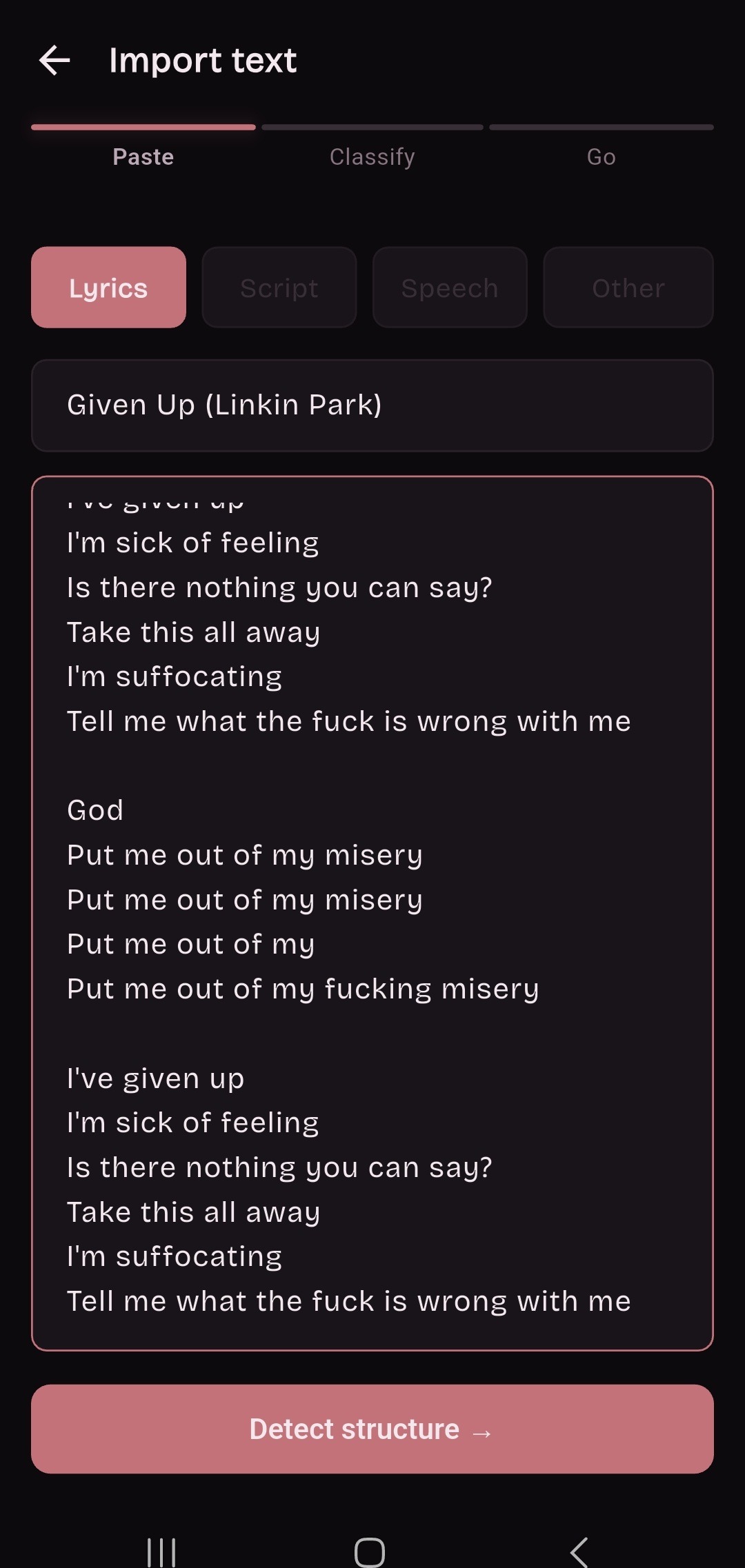
ReciteFlow import screen with Given Up by Linkin Park pasted as lyrics and the Detect structure button
Step 2: let it find the sections. Smart section detection splits the text into verses, choruses and bridges. For this song the result is 37 lines in 8 sections, with a first session estimated at about 6 minutes. Read the note on that screen: repeated sections are learned once and tested at each occurrence point. That's the chorus rule from the previous section, handled automatically.
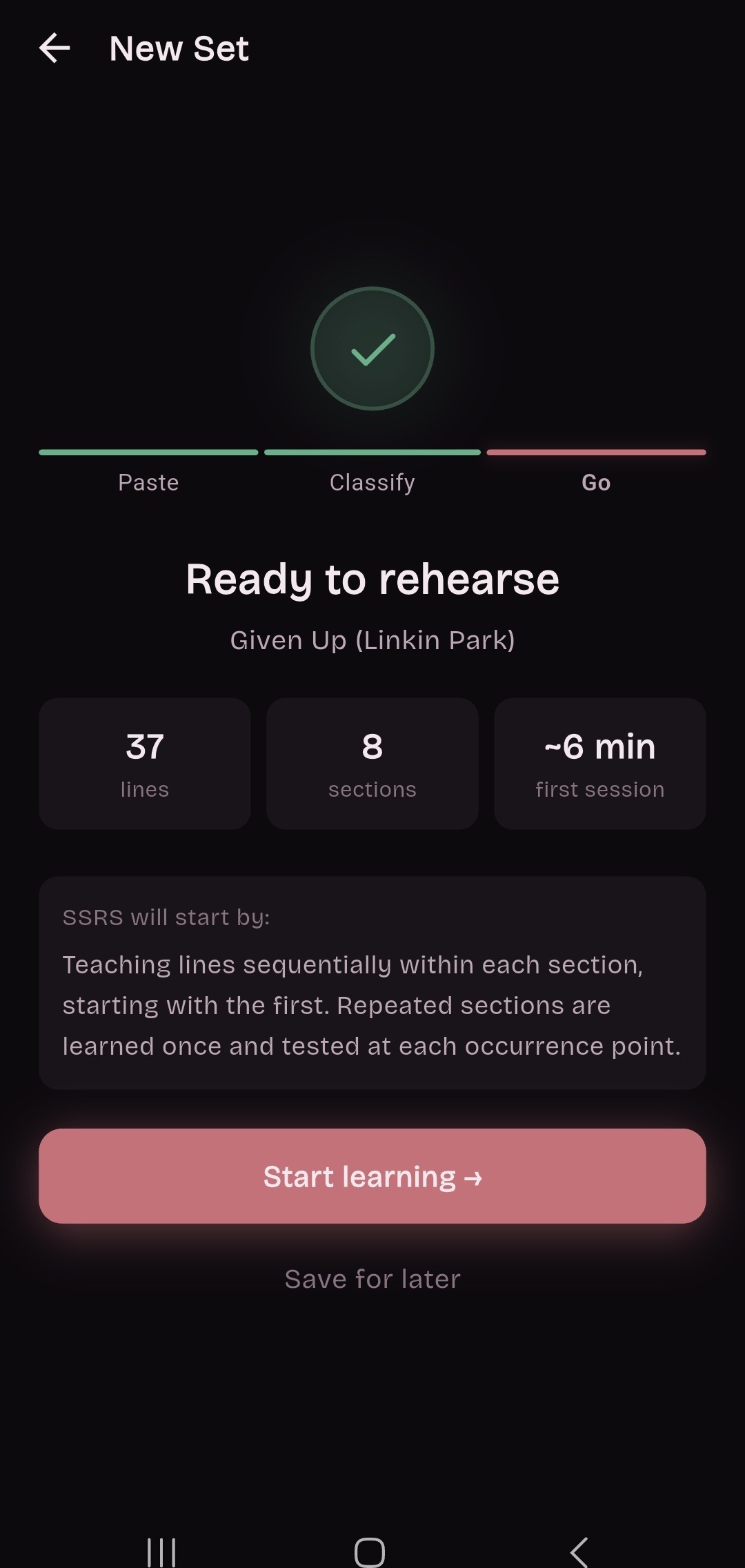
ReciteFlow ready to rehearse screen showing 37 lines, 8 sections, about 6 minutes for the first session
Step 3: previous line, next line, reveal. Every card shows you the line you just sang and hides the next one. In the screenshot below we're on line 2 of 37, Section 1. The previous line is "Wake in a sweat again." The next one is blurred until you tap. Your job is to recall it before you tap, out loud if you can. That's the cue-and-recall chain, one pair at a time, in order.
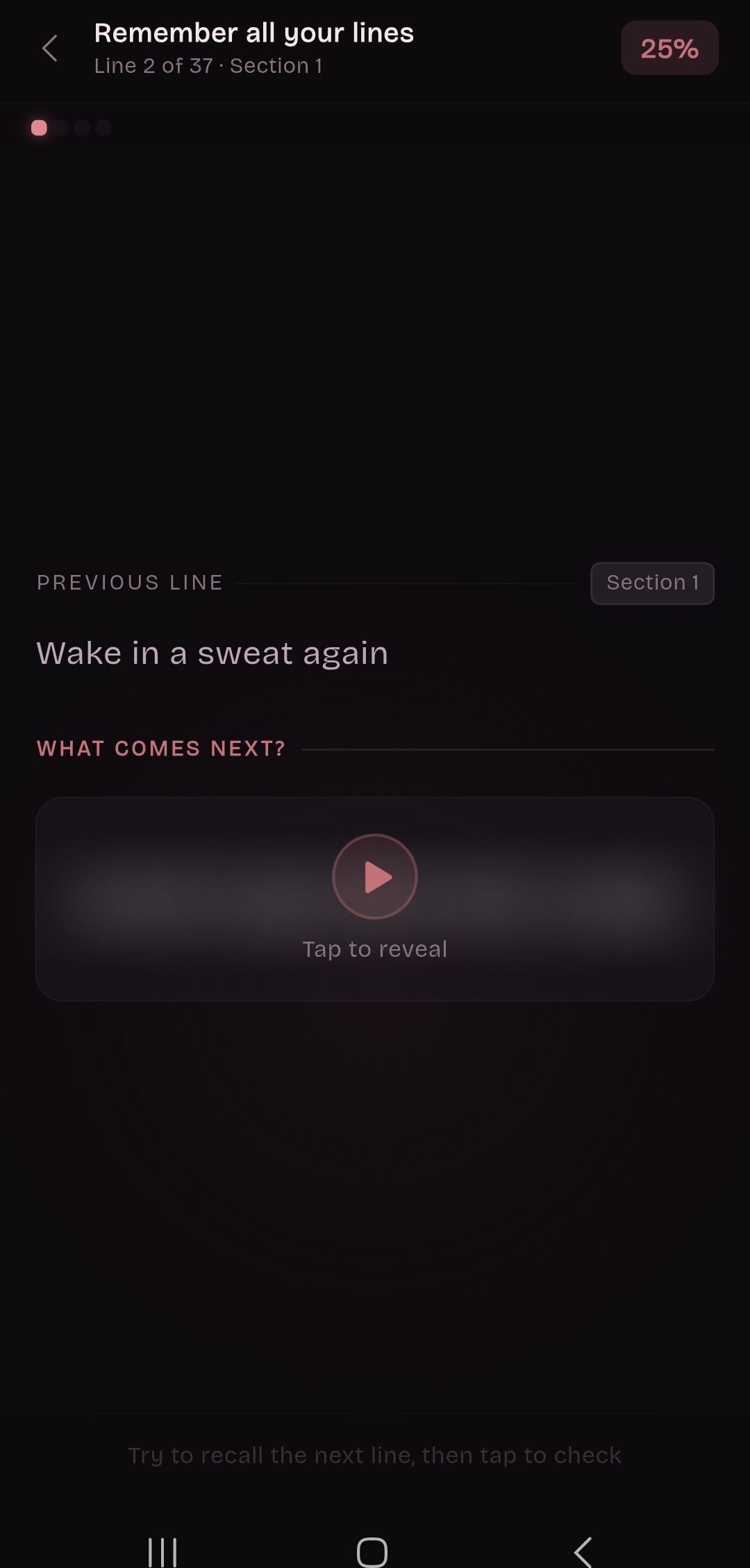
ReciteFlow practice card showing the previous line and a hidden next line with a tap to reveal prompt
Step 4: rate yourself honestly. Once revealed, you pick one of five ratings: Blank, Shaky, Close, Solid or Instant. The rating decides when the line comes back. Blank means you'll see it again very soon, probably within the same session. Shaky and Close bring it back on a short interval. Solid pushes it further out. Instant pushes it furthest. That's the spacing rule, and the only thing you have to do is tell the truth about how it came out.
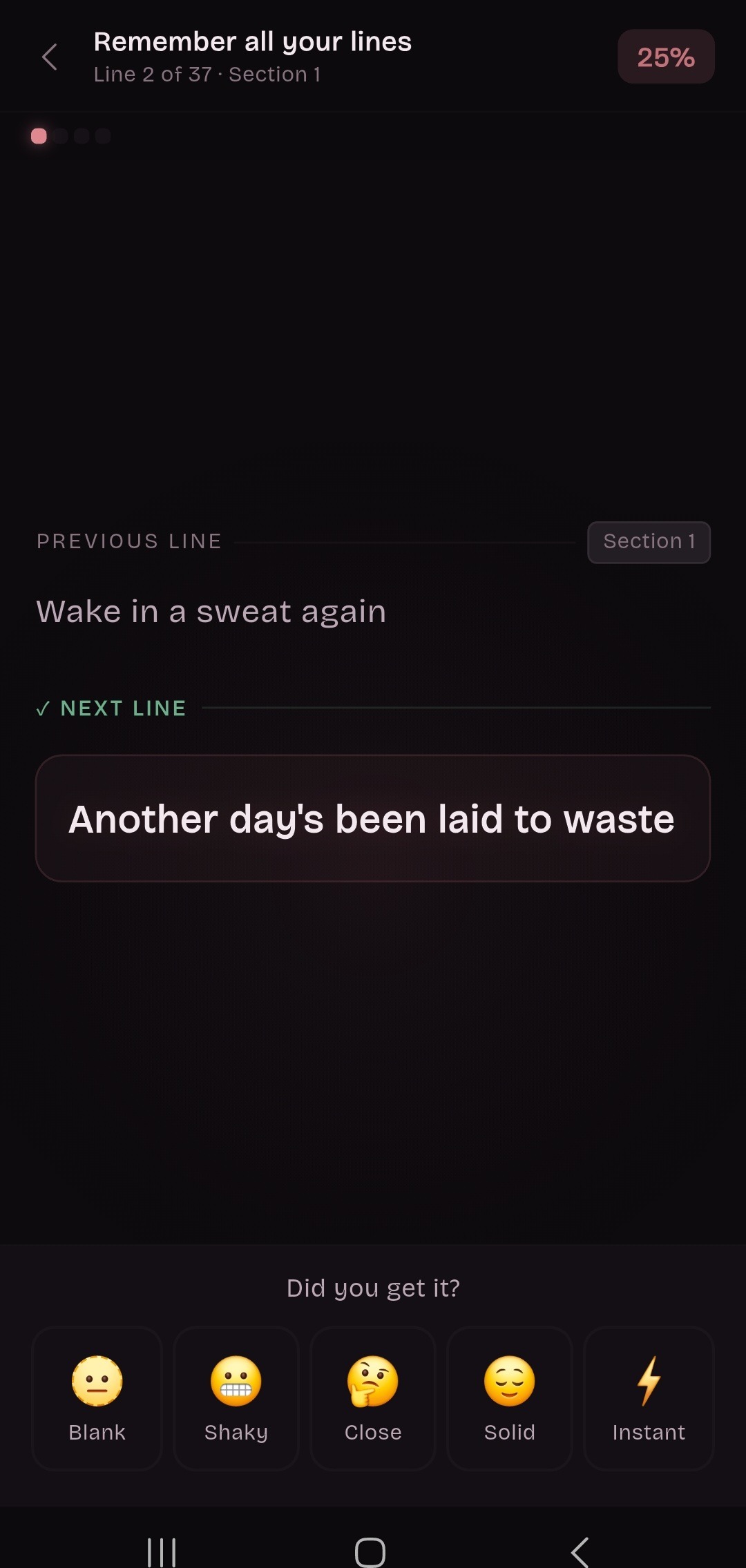
ReciteFlow card after reveal showing the next line and the five rating options Blank, Shaky, Close, Solid and Instant
A word on honesty here, because it matters more than any feature. "Close" means you got most of the words but swapped one or hesitated. If you rate that as Solid because you're in a hurry, the app trusts you and pushes the line out, and it comes back to bite you on Saturday. Rate what happened, not what you wish had happened.
Step 5: set the performance date. This is the piece built for the Saturday problem. Set the date of the show and the algorithm compresses the review intervals so the whole piece is scheduled to be ready by then, spending more reviews on your weakest lines as the date gets close. The home screen flags what needs attention (something like "11 lines dropping below threshold") and offers a quick drill of about 2 minutes to fix just those. That's your soundcheck-day routine: open the app, run the drill, done.
A few other things worth knowing. Each set shows confidence, mastered lines, weak spots, estimated sessions to mastery and a section map, with a score on every line, so you can see at a glance that verse 3 is the problem. There's a run-through mode for the whole piece when you want the full-song pass. And you can export a set as a .reciteflow file, optionally with your progress, and send it to a bandmate who imports it. Everything stays on your device: no account, no tracking, no internet needed. The interface is in English and Spanish.
Platform and money, plainly: ReciteFlow is on Google Play for Android. iOS is on the roadmap with no date, so if you're on iPhone, the paper method below is your route for now. The free version includes the full SSRS, performance deadlines, section detection, and share and export for up to 3 sets, which covers a three-song Saturday exactly. Pro is $4.99, one time, and adds unlimited sets, hint modes (first letter, fill the gap, full blind), folders with drag and drop, and a light theme. Details at reciteflow.com.
The four-day plan: three songs by Saturday
It's Wednesday night. Three songs, roughly 35 to 40 lines each. Here's how I'd split it, with the paper version and the app version side by side. Budget about 20 to 30 minutes a day. More isn't better here, you'll just be re-training verse one again.
Wednesday: first pass on all three songs. Do not sing any song top to bottom yet. Take song one, section by section: cover the page, cue yourself with the previous line, produce the next, check, mark it. Every line gets a mark: a tick for clean, a dot for shaky, a cross for blank. Learn each chorus once and then only test its entry line where it reappears. Do the same for songs two and three. You will not feel ready tonight. That's correct.
With the app: paste all three songs, set the performance date to Saturday on each, and run the first session on each one (about 6 minutes per song at that length). Rate honestly.
Thursday: weak lines first, then the joins. Start with every line you marked with a cross or a dot. Drill those as pairs until they come out. Then work the section joins: last line of one section cueing the first of the next. Only after that, do one full run-through per song with the paper face down. Mark anything that stumbled. Do not repeat the run-through; the stumbles are your list for tomorrow.
With the app: open it, the home screen tells you how many lines are below threshold. Run the quick drill, then the session it's queued for you. One run-through per song at the end if you have time.
Friday: mostly review, one run-through each. By now most lines are solid and you have a short list of troublemakers, probably in a bridge or a late verse. Drill those, then one full run-through per song, ideally singing with the track at performance tempo. Whatever stumbles goes on tomorrow's list. Then stop. Really. Get sleep.
With the app: quick drill in the morning, quick drill in the evening, run-through mode once per song. Check the section map: if any section still shows weak spots, that's your Saturday morning target.
Saturday: drill the short list, run once, leave it alone. Morning: drill only the lines that stumbled Friday. Afternoon: one run-through per song, no track, standing up, at volume. If a line fails, drill that pair three times and move on. Then put the songs away until soundcheck. Cramming on show day trains anxiety, not lyrics.
With the app: the performance date means Saturday's session is already weighted toward your weakest lines. Run the 2-minute quick drill before you leave the house and once more backstage. Done.
Quick tip: after the gig, don't drop the songs. One short review on Sunday and one midweek keeps them for the next show at a fraction of the cost. The lines that failed on stage go straight back to the front of the queue.
Questions people also ask
How long does it take to memorize a song?
For a typical 35 to 40 line song, a first pass takes 5 to 10 minutes and you can be performance-ready in three to four days of short daily reviews. What matters more than total hours is that the reviews are spread across days and aimed at the lines you keep missing.
Should I just sing the song over and over to memorize it?
No. Full run-throughs over-train the first verse and under-train the last one, and they hide which specific lines are weak. Learn it in sections as a chain of cue-and-recall pairs, then use run-throughs only to find the stumbles.
Does ReciteFlow work on iPhone?
Not yet. ReciteFlow is Android only, available on Google Play, and an iOS version is on the roadmap without a date. The method in this post works on paper in the meantime.
Is ReciteFlow free?
Yes for up to 3 sets, with the full SSRS, performance deadlines, section detection and share and export included. Pro is a one-time $4.99 and adds unlimited sets, hint modes, folders and a light theme.
Can I share a set list with my band?
Yes. A set exports as a .reciteflow file, with or without your progress, and a bandmate imports it into their own app. Everything stays on your devices, no account involved.
That's the whole method: in order, one line cueing the next, reviews spaced by how well each line came out, chorus learned once. Do it on paper or let ReciteFlow keep score for you. Either way, if you've got a Saturday gig and songs still on paper, start tonight with verse three. Got a trick that works for you? Drop it in the comments, I read every one.

Pablo Dominguez
Full Stack Developer passionate about building interesting projects and learning new skills.