
The Routine That Wasn't Mine
For about two years I warmed up with the same twelve-minute video. Every day. Lip trills, sirens, a five-note pattern on Nay, an arpeggio on Ya, done. It was a good video. The problem was that I sang long, sustained lines in a choir, and that routine was built for someone who sang pop runs.
Sounds familiar? You do the exercises, you feel warmer, and then you open your mouth for the actual music and the thing you needed (breath for a 12-second phrase, a clean top note, a fast passage) still isn't there.
Here's what I tell students who ask me how to build their own routine: a warmup is a plan, not a playlist. Once you understand the structure and the three dials that change every exercise, you can build one that matches what you actually work on. And you can rebuild it next month when your repertoire changes.
Let's start with the structure. Then we'll get into the app answer, because writing it on paper is fine but having it play back in your range is better.
The Five Parts of a Warmup That Fits You
Every solid routine I've seen, from conservatory teachers to touring session singers, breaks down into the same five jobs. Not every routine needs all five, but you should know which ones you're skipping and why.
1. The opener: wake the voice, don't stretch it. Hums, lip trills, gentle five-note patterns sitting right in the middle of your range. Nothing high, nothing loud. Think of it like walking before you jog. Three to five minutes is plenty.
2. Range work: climb and descend gradually. Octave scales, arpeggios, interval jumps. The word that matters is gradually. You go up a half step at a time, you come back down, and you stop a note or two before the edge. The top of your voice should feel like it arrived, not like you dragged it there.
3. Agility (if you sing runs). Fast five-note patterns, pulses, arpeggios at speed. If your repertoire is hymns and ballads, you can keep this to a minute or skip it. If you sing R&B, gospel, musical theatre or anything with melisma, this is where a chunk of your time goes.
4. Sustain and breath (if you sing long lines). Slow scales, held notes, smooth connected phrases at a tempo that makes you plan your air. Choir singers, classical singers, anyone who holds a note across a full bar: don't skip this one.
5. Cooldown. Descending patterns on a closed vowel like Oo, soft and slow, back into the middle. Two or three minutes. Most people skip it. Most people also wonder why their voice feels tired the next morning.
Here's a 20-minute template you can shrink or stretch:
- Opener: 4 minutes
- Range work: 5 minutes
- Agility: 4 minutes (or 1 if you don't sing runs)
- Sustain and breath: 4 minutes (or 1 if you don't sing long lines)
- Cooldown: 3 minutes
Got 10 minutes? Halve everything except the opener. Got 30? Add time to the section that matches tonight's repertoire, not to all of them equally.
Syllables, Attack and Tempo: The Three Dials
Now, let's talk about why the same five-note scale can be four completely different exercises. There are three dials on every step, and most students only know about one of them.
Dial one: the syllable. The vowel and consonant you sing on change where the sound sits.
- Mee: forward placement. The closed E vowel and the M consonant pull resonance toward the front of the face. Great for finding focus and for the top of the range.
- Nay: brightness. The nasal N plus the open A adds ring and "twang". If your sound is muffled or falls back in the throat, Nay pulls it out.
- Ya: openness. The Y glide into a wide Ah opens the throat and the jaw. Use it when you're tight, or when you're building the big, warm middle of your voice.
Dial two: the attack. Do you separate every note or connect them?
Struck means a crisp onset and clear separation between notes. It's the drill for runs, because a run is only clean if every note actually lands. Smooth means gliding between notes, legato, no gaps. It's the drill for long lines and for finding an even tone across a register shift. Normal sits in between: relaxed and speech-like, the default for most range work.
Dial three: tempo. This is the one everyone underestimates. Take a plain five-note scale on Nay. At 130 bpm with a struck attack, it's an agility drill: your job is precision at speed. Drop the same scale to 50 bpm with a smooth attack and it becomes a support drill: your job is a steady stream of air across a phrase that suddenly feels very long.
Same notes, different tempo, different muscle. If you only ever practice one speed, you're only ever training one thing.
Quick tip: when you're not sure what a step is for, ask yourself which dial you'd turn to make it harder. If the honest answer is "faster", it's an agility step. If it's "slower", it's a breath step. If it's "higher", it's range. That question alone will tidy up most homemade routines.
Building It Step by Step in Scalita
I get that you could do all of this on a piano app and a notebook. I did for years. The problem is transposition: you write "five-note scale on Nay, climb by half steps", and then you spend half the warmup finding starting notes instead of singing. Scalita was built to remove that. You build a routine one step at a time, and every step transposes to your range automatically.
A step is exactly the three dials we just talked about, plus a couple of extras. Here's the edit screen for one:
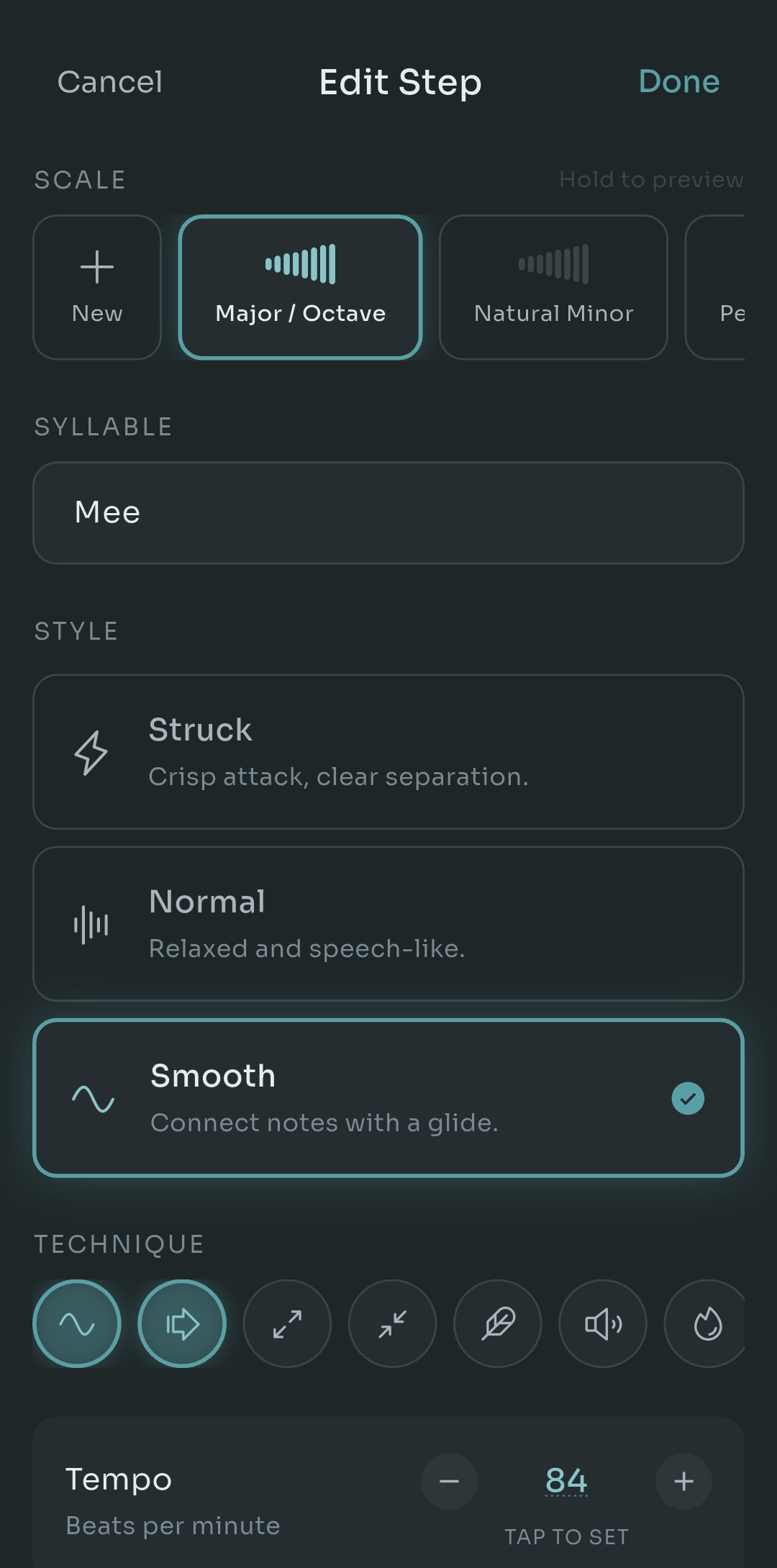
Scalita Edit Step screen showing a Major / Octave scale selected, the syllable Mee, the Smooth style chosen, technique toggles, and a tempo of 84 bpm
Top to bottom: you pick a scale (Major / Octave is selected here, with Natural Minor and Pentatonic next to it), type your syllable (Mee), choose the style between Struck, Normal and Smooth, flip on any technique toggles you want reminded of (legato and forward placement are lit up in that screenshot), and set the tempo. Repeats live in the same step, so a Three Pulses exercise can run five times at 120 bpm without you touching the phone.
For the scale itself, you start from a library of 21 built-in patterns. Hold any of them to hear it before you commit.
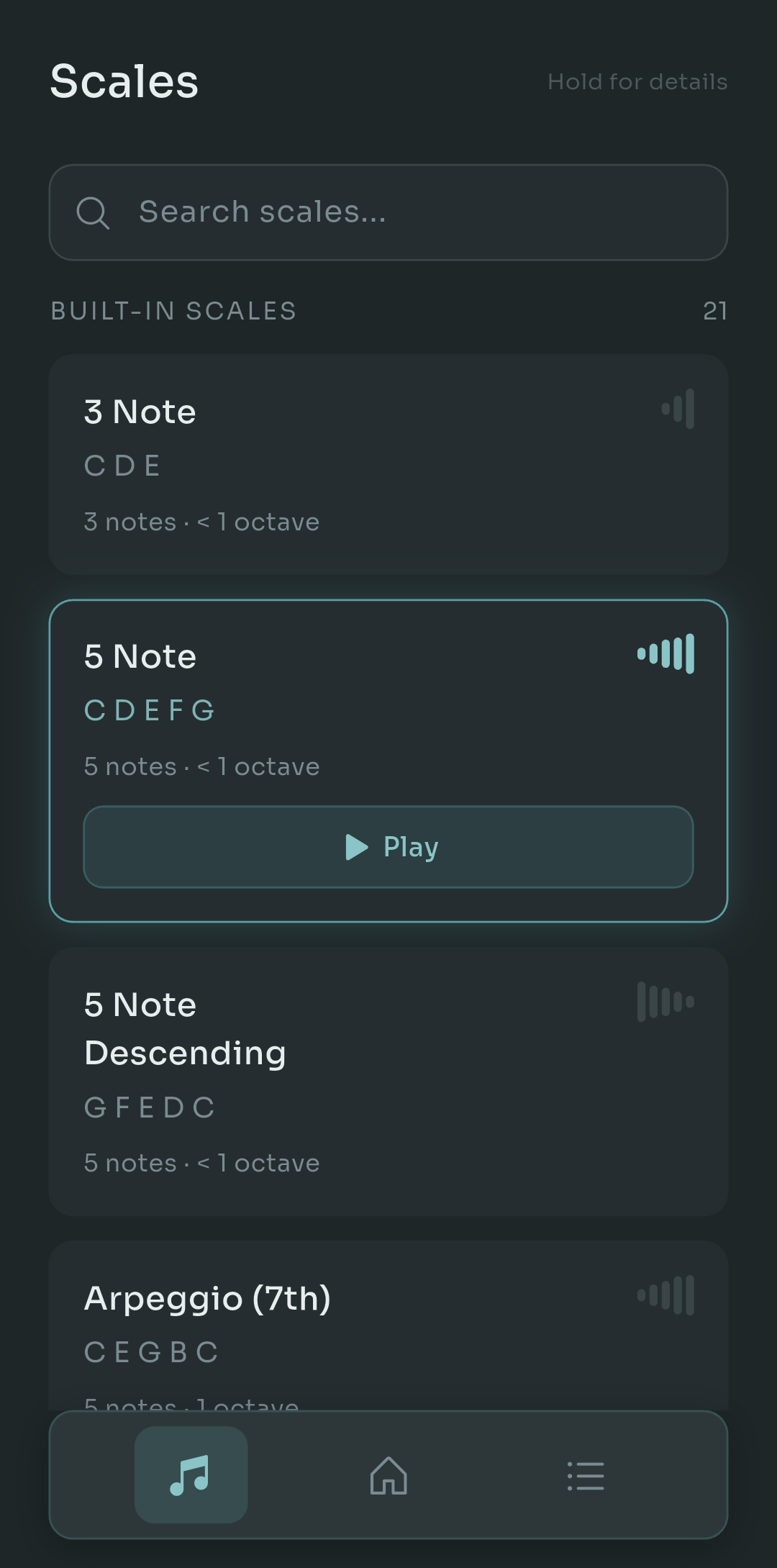
Scalita Scales list showing 21 built-in scales including 3 Note, 5 Note, 5 Note Descending and Arpeggio (7th), with a play button on the expanded 5 Note card
The ones you see there (3 Note, 5 Note, 5 Note Descending, Arpeggio to the 7th) cover most of a warmup on their own. But your teacher probably gave you something that isn't on any list. Maybe a seven-note climb with a chromatic twist. That's what custom scales are for: tap the notes in order on the keyboard, add rests if you want them, preview it, name it, save it.
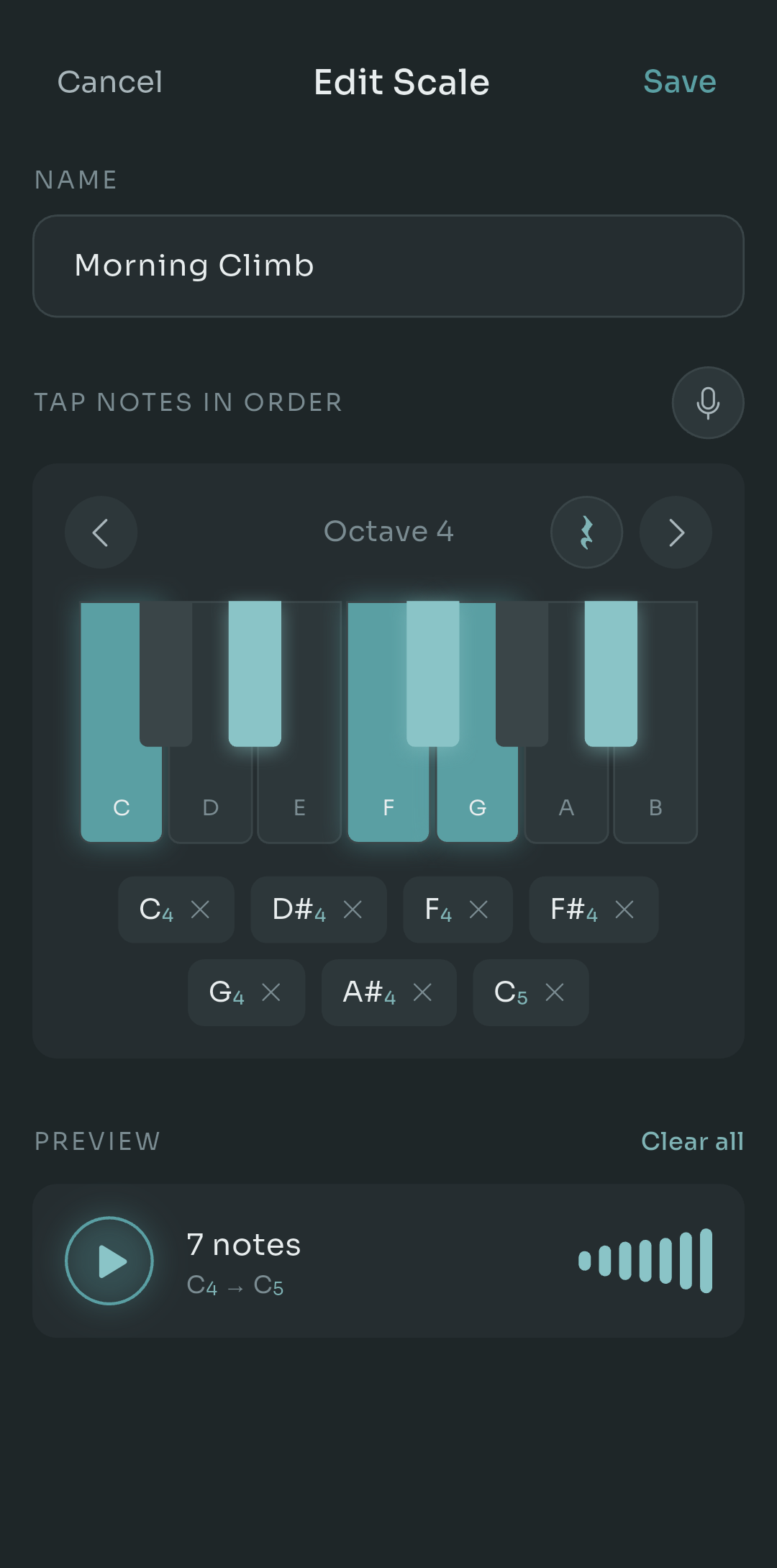
Scalita Edit Scale screen building a custom seven-note scale called Morning Climb from C4 to C5 by tapping keys on a piano keyboard, with a preview player at the bottom
That "Morning Climb" scale is seven notes from C4 to C5 with a couple of sharps thrown in. Once it's saved it shows up next to the built-in ones, and you can use it in any step. Note names display as letters or solfège, whichever you learned with.
When the steps are in place, the routine screen shows you the whole plan at a glance. This is one of the 14 built-in routines, a subharmonic warmup that deliberately stays low and narrow:
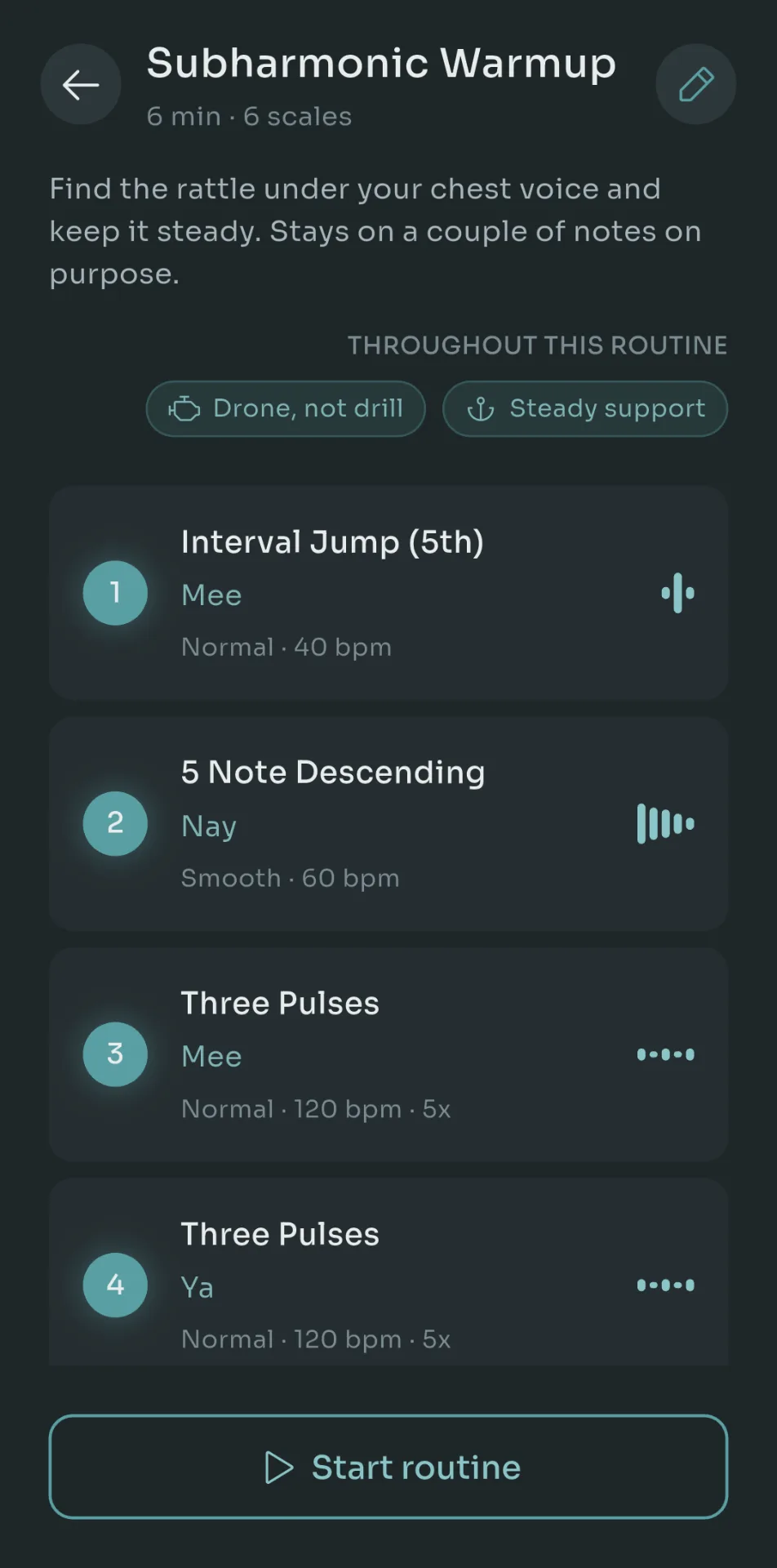
Scalita routine overview for a six-minute Subharmonic Warmup with four steps listing scale, syllable, style, tempo and repeats, plus two routine-wide cues: Drone, not drill and Steady support
Look at how much is in that one screen. Each step has its scale, syllable, style, tempo and repeats: an interval jump on Mee at a slow 40 bpm, a descending five-note on Nay smoothed out at 60, then two rounds of Three Pulses at 120, five times each, first on Mee and then on Ya. Above the steps are two cues that stay on screen for the whole routine: "Drone, not drill" and "Steady support". That's the teacher's voice in the room when the teacher isn't there. You can add cues per step too.
A few practical notes before the examples:
- The 14 built-in routines are the best starting point. Run a few, notice what you'd change, then change it.
- The free tier gives you 1 custom routine and 3 custom scales. Enough to build one honest routine that's yours.
- Pro is a one-time $4.99. It lifts those caps and lets you edit the built-in routines directly instead of starting from a blank list.
- It's Android only, available in five languages, and free to download.
Three Routines You Can Rebuild Tonight
Here are three routines I've built for students. Each one follows the five-part structure, and each one is written as steps so you can rebuild it in Scalita (or on paper, no judgement). Adjust the tempos by 10 bpm either way until they feel like work without feeling like strain.
The 10-Minute Morning Opener
Routine cue: "Wake it, don't stretch it." Stays in the middle of your range the whole time.
- 3 Note, hum on Mm, Smooth, 60 bpm, 2 minutes. Cue: lips buzzing, jaw loose.
- 5 Note, lip trill on Brr, Smooth, 70 bpm, 2 minutes.
- 5 Note Descending, Nay, Normal, 80 bpm, 3 minutes. Climb a few half steps, no further.
- Interval Jump (5th), Mee, Smooth, 60 bpm, 2 minutes. Glide the jump, don't leap it.
- 5 Note Descending, Oo, Smooth, 50 bpm, 1 minute. Soft, back to the middle.
The 20-Minute Agility Session
Routine cue: "Every note lands. Speed comes from clarity." Notice how the tempo climbs across the middle steps and the attack switches to Struck the moment agility begins.
- 5 Note, Mee, Smooth, 70 bpm, 3 minutes. Opener.
- Major / Octave, Ya, Normal, 80 bpm, 3 minutes. Range, climbing gradually.
- 5 Note, Nay, Struck, 100 bpm, 3 minutes. First agility pass.
- 5 Note, Nay, Struck, 130 bpm, 3 minutes. Same scale, faster. If a note smears, drop 10 bpm.
- Arpeggio (7th), Mee, Struck, 110 bpm, 3 minutes.
- Custom 9-note run (C D E F G A G F E or your own), Struck, 120 bpm, 3 minutes.
- 5 Note Descending, Oo, Smooth, 55 bpm, 2 minutes. Cooldown.
The 15-Minute Pre-Show
Routine cue: "You've done the work. Now just sing." A pre-show isn't practice. You're not fixing anything an hour before a gig. You're waking up, touching the top once, checking your breath, and stopping while you still feel good.
- 3 Note, hum on Mm, Smooth, 60 bpm, 2 minutes.
- 5 Note, Mee, Normal, 80 bpm, 3 minutes.
- Major / Octave, Ya, Smooth, 70 bpm, 3 minutes. Touch your top note twice, then come down.
- Interval Jump (5th), Nay, Struck, 90 bpm, 2 minutes. Brightness for the mix.
- 3 Note held on Ah, Smooth, 40 bpm, 3 minutes. Long, steady, planned air.
- Hum through the first verse of your hardest song, then stop. 2 minutes.
One warning: the pre-show is the routine people are most tempted to extend. Don't. If you're warm at 15 minutes, another 15 only spends voice you'll want on stage.
Where to Start
If you take one thing from this: your warmup should be shaped by what you sing afterward. Choir singer? More sustain, less agility. Musical theatre? Agility and a bright Nay. Low, heavy stuff? A slow, narrow opener and a lot of Ya.
Here's the trick to getting started without overthinking it: pick one of the three routines above, run it for a week, and change one step at a time. Swap Nay for Mee on the range work. Drop the agility tempo. Add a cue that's actually your teacher's words. After three weeks you'll have something that's genuinely yours, and you'll know why every step is there.
If you're on Android, grab Scalita, run a couple of the built-in routines, then build your one free custom routine from whichever example fits your voice. If you're a teacher, build the routine you'd give a student and hand it over. It'll transpose to their range, not yours.
And I'd genuinely like to know: what does your current warmup do that doesn't match what you sing? Drop it in the comments. Odds are the fix is one dial away.

Pablo Dominguez
Full Stack Developer passionate about building interesting projects and learning new skills.