
The short answer
Memorize it exactly, one sentence at a time, in order, and learn the first sentence of every paragraph until it's automatic. Then practise out loud by recalling the text, not by re-reading it. Do that and on the day you'll have enough spare attention to look at people, pause, and actually say the thing instead of reciting it.
The reading sound doesn't come from memorizing too much. It comes from memorizing the wrong unit (words instead of ideas) and from treating the whole speech as one long string. If you want an app to run the drills, ReciteFlow is an Android app I built that takes a pasted speech, splits it into paragraphs, and quizzes you one sentence at a time with the previous sentence as the cue. It's Android only for now, with iOS on the roadmap and no date yet. The free version covers up to 3 sets, Pro is $4.99 once, and the interface is in English and Spanish. More on that further down, but first the method, because the method works with or without the app.
Why a memorized speech sounds like reading
I perform, and the first time I recited something I'd "learned" in front of people, a friend told me afterwards: "You sounded like you were reading off the ceiling." Eyes up, voice flat, same pace for every line. Sounds familiar?
There are two causes, and they're worth separating because they have different fixes.
First: you're recalling words, not thoughts. When your brain retrieves a string of words, it does it the way it retrieves a phone number. Even rhythm, no stress on anything, and your eyes drift because you're searching. When you retrieve a thought and let the words come out behind it, the emphasis lands where the meaning is. That's what a natural voice sounds like. The good news is you can train the recall so that the words are attached to the thought, not floating free.
Second: the speech is one undifferentiated block. No landmarks. If you lose one word you lose the whole thing, so you don't dare pause, and you rush to stay ahead of the blank. Think about driving a route you know well: you don't recall every turn, you recall the landmarks and the turns fill in between them. A speech with no landmarks is a route with no landmarks. Every metre feels like a place you could get lost.
Fix those two things and you fix the reading sound. Here's how.
The fix: signposts first, then the sentences behind them
- Split the speech into paragraphs that each carry one idea. For a best-man speech that might be: how we met, the story, what she changed in him, the toast. For a thesis defence: the question, why it matters, what you did, what you found, what's next. If a paragraph holds two ideas, split it. Eight to twelve paragraphs is typical for ten minutes.
- Learn the first sentence of each paragraph cold. These are your signposts. Test yourself out of order: pick paragraph 5, say its opener, pick paragraph 2, say its opener. When you can do that from anywhere, you can never be fully lost on stage, because the next signpost is always one jump away.
- Learn the rest of each paragraph in order behind its signpost. Each sentence is cued by the one before it. Don't skip around. The chain is the point: sentence 3 should pull sentence 4 out of you without effort.
- Practise out loud with recall, not re-reading. Cover the text, say the sentence, uncover, check. Re-reading feels productive and proves nothing. Saying it aloud with the text hidden is the only test that matches what you'll do on the day.
Now, let's talk about the objection I hear most. I get that memorizing word for word sounds like exactly the way to end up robotic. Surely learning it "loosely" and improvising the wording is more natural?
In my experience it's the opposite. Loose memorization means you're doing two jobs on stage at once: remembering the structure and composing sentences in real time. That's where the "um", the restarts and the ceiling-stare come from. Exact memorization gives you a floor. On the day you can loosen: swap a word, add a line about the room, slow down on the bit that's getting a laugh. And if you slip, you land back on the exact text you drilled. Actors work this way. The script is fixed to the letter, and that's precisely what lets the performance move.
Memorize exactly so you can loosen freely. Memorize loosely and you'll tighten up on stage.- Pablo Domínguez
Quick tip: when you drill, stand up. Sitting recall and standing recall feel different to the body, and you'll be standing when it counts.
How ReciteFlow runs these drills for you
You can do all of the above with a printed page and your hand over the text. I did it that way for years. But here's the trick: the hard part isn't the method, it's keeping track of which sentences are solid and which ones only feel solid. That's what ReciteFlow does.
Here's the import screen. You paste the text, give it a name, pick one of four types (Lyrics, Script, Speech, Other) and tap Detect structure. The set in this screenshot happens to be a song, so Lyrics is selected; for your toast you'd pick Speech, and the detector treats every paragraph as a section. That's step one of the method done for you. The set details then tell you the line count, the section count and an estimate for the first session, something like 37 lines, 8 sections, about 6 minutes.
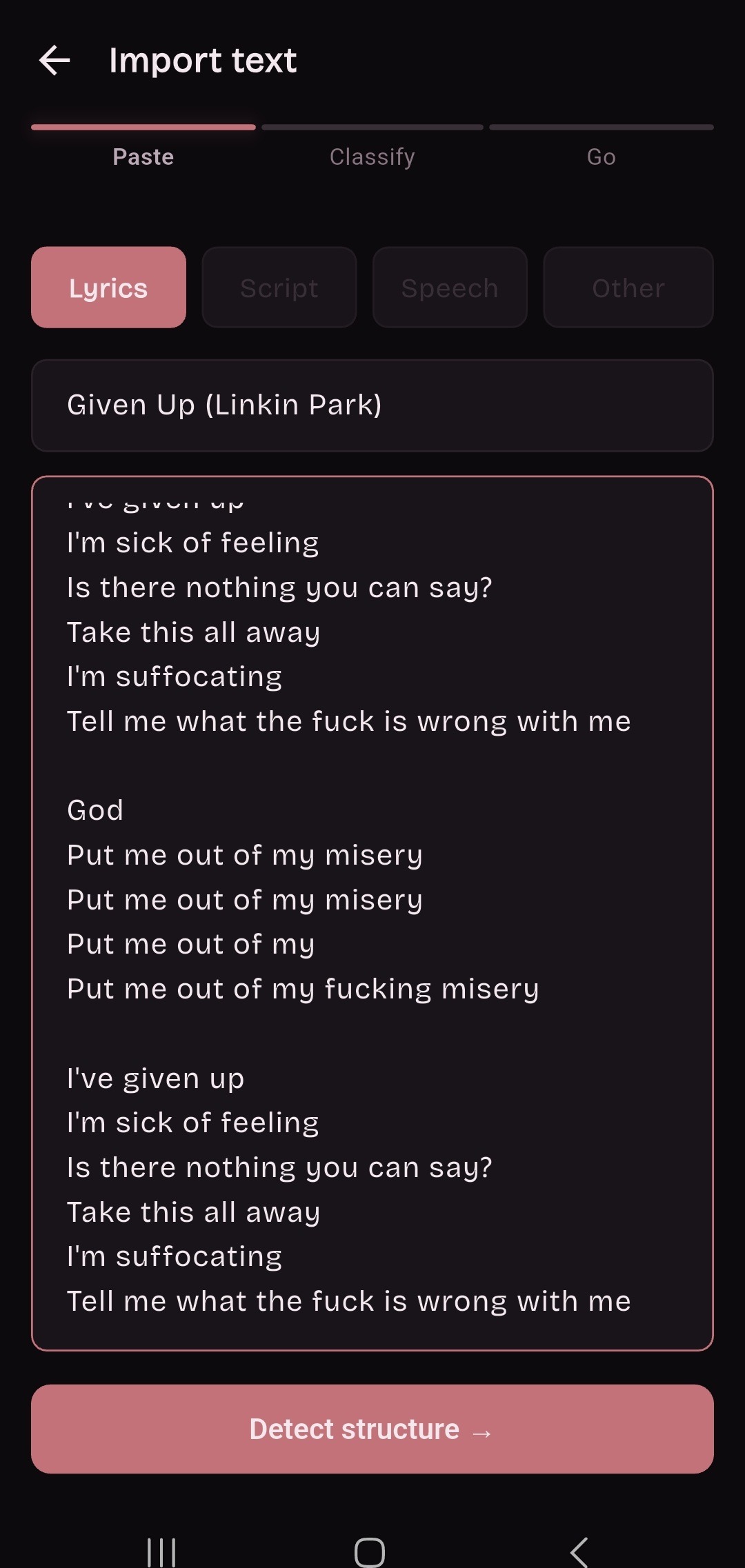
ReciteFlow import screen with pasted text, type chips for Lyrics, Script, Speech and Other, and a Detect structure button
The drilling uses what I call SSRS, a Sequential Spaced Repetition System. Spaced repetition is well established: a line you got right comes back later, a line you fumbled comes back soon. The sequential part is what makes it fit a speech. Lines are learned in the order they're performed and never shuffled. Standard flashcard apps shuffle the deck, and shuffling breaks the very chain (this sentence cues the next one) that you're trying to build.
This is the recall card. It shows the previous line ("Wake in a sweat again") and asks what comes next. You say it out loud, tap to reveal, and rate yourself Blank, Shaky, Close, Solid or Instant. That rating decides when the line comes back. Look at the header: Line 2 of 37, Section 1. Always in order, always cued by the line before.
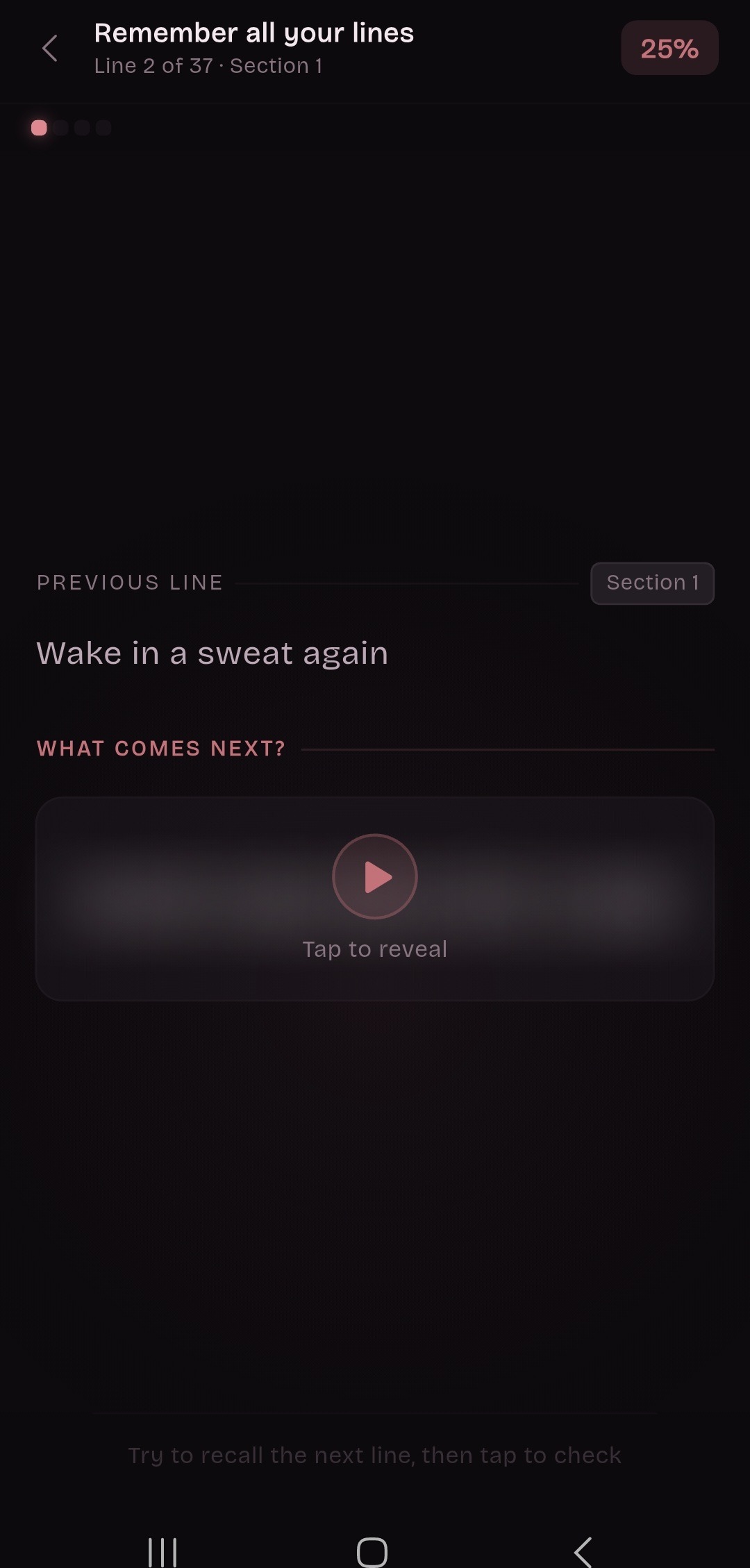
ReciteFlow recall card showing the previous line and a blurred next line with a Tap to reveal prompt
And this is the set screen, which is where the honesty lives. At the top: performance date Tuesday, Mar 31, 51 days left, SSRS adjusted. Then confidence 3%, 1 line mastered, 0 weak spots, 1 of 37 lines learning, and an estimate of about 8 more sessions to mastery. Below that, every line with its own score: line 1 sits at 5/5, the rest at 0/5 because this set has only had one review. In a speech, the lines that stay low are almost always the transitions, the first sentence after a paragraph break. Which, if you read the method above, are exactly the sentences you can't afford to have weak.
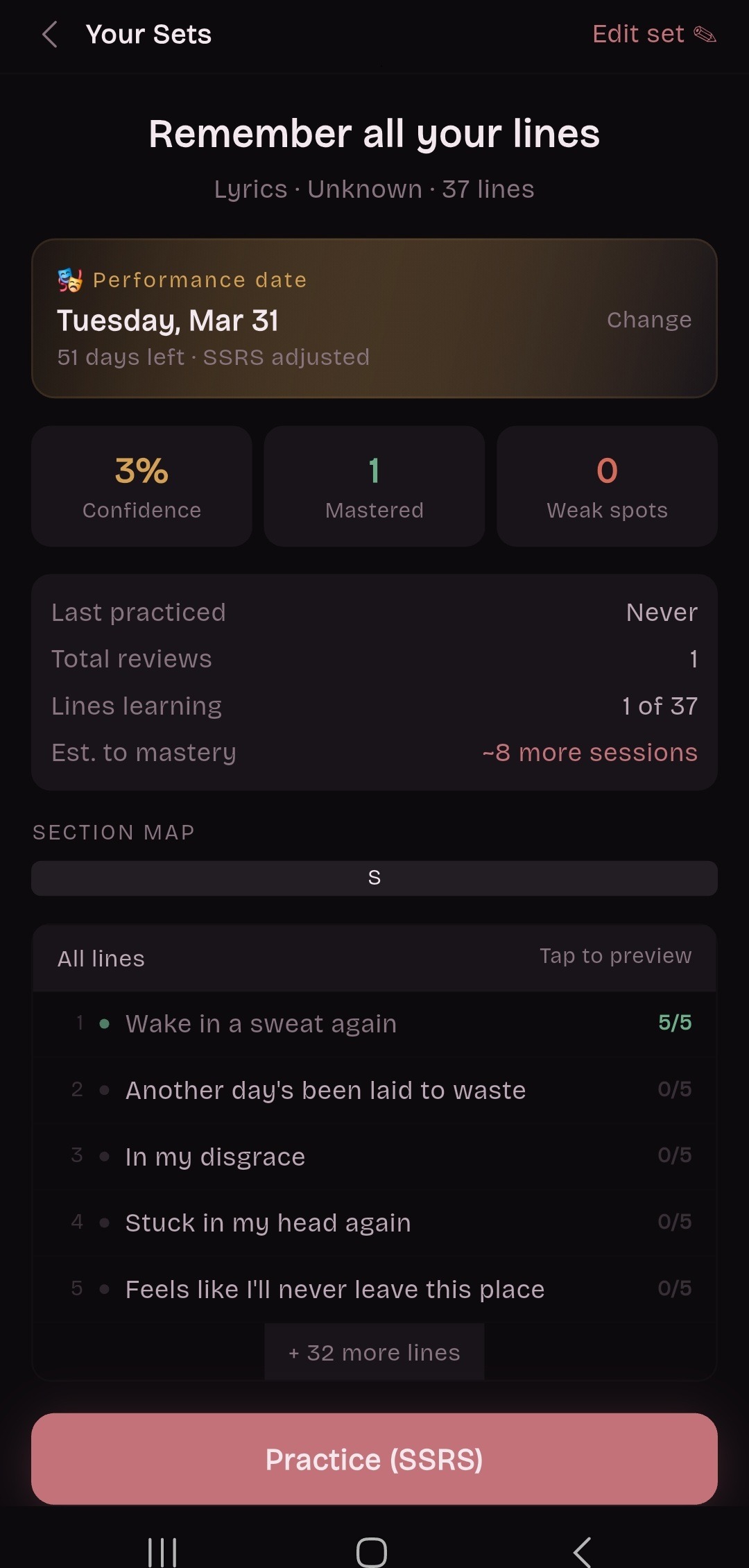
ReciteFlow set details with a performance date, confidence and mastered counts, and a list of every line with its score out of 5
Three more pieces matter for a speech with a date on it.
Performance date. Set the day of the talk and the algorithm compresses the review intervals so the whole piece is ready by then, spending more reviews on the weakest lines as the date gets close. The home screen flags what needs attention (for example, 11 lines dropping below threshold) and offers a quick drill of about 2 minutes.
Run-through mode. The whole piece, start to finish. This is your dress rehearsal, and it's the closest the app gets to standing in the room. Pro adds hint modes (first letter, fill the gap, full blind) if you want to tighten the screws.
Privacy. Everything stays on the phone. No account, no tracking, no internet needed. That matters more than usual for a speech, because a best-man speech or a defence nobody has read yet is not something you want sitting on a server.
Pricing is simple. Free covers up to 3 sets with the full SSRS, performance deadlines, section detection, and share and export. Pro is $4.99 one time and adds unlimited sets, hint modes, folders and a light theme. The interface is in English and Spanish, and there's more at reciteflow.com. Android only for now; iOS is on the roadmap with no date.
The seven-day plan
This assumes a talk of five to ten minutes, and about 15 to 20 minutes of practice a day. If your speech is three minutes, compress it; the order stays the same.
- Day 1: Finish the draft. Read it aloud once with a timer. Split it into paragraphs of one idea each. Paste it into ReciteFlow as Speech, check the detected sections match your paragraphs, and set the performance date.
- Day 2: Signposts only. Learn the first sentence of every paragraph. Test yourself out of order, out loud, until you can name any opener on demand.
- Day 3: The first half of the paragraphs, in order, behind their signposts. Rate yourself honestly. A Close is not a Solid.
- Day 4: The second half. Then clear whatever the home screen flags as due.
- Day 5: First full run-through, standing up, out loud. Check the per-line scores afterwards and drill the low ones.
- Day 6: Two run-throughs. One at pace, one slow with deliberate pauses where you want people to laugh or think. Say it to a person if you can. Start loosening: change a word, look up.
- Day 7: Clear the quick drill in the morning, one run-through, then stop. Don't read the text again before you stand up. You know it.
After seven days like this, what you'll notice is that the speech stops being a thing you recite and becomes a route you know. You'll pause because you can afford to. You'll look at the couple, or the committee, because your eyes aren't searching for the next word. That's the whole goal.
Questions people also ask
How long does it take to memorize a 10-minute speech?
A ten-minute speech is roughly 1,200 to 1,500 words at a normal speaking pace, so around 50 to 70 sentences. With 15 to 20 minutes a day of recall practice, one week is realistic for most people. Two weeks is comfortable.
Should I memorize a speech word for word or just the key points?
Word for word, then loosen on the day. Key points alone leave you composing sentences on stage, which is where the stalls and the flat voice come from.
Is it okay to have notes for a best-man speech?
Yes, one card with your signposts (the first sentence of each paragraph) is plenty. If you've drilled properly you'll rarely look at it, but knowing it's there lets you relax.
What do I do if I go blank in the middle?
Pause, breathe, and jump to the next signpost. Nobody in the room knows what you skipped. This only works if you learned the signposts cold, which is why they come first in the plan.
Does ReciteFlow work on iPhone?
Not yet. It's on Google Play for Android, and an iOS version is on the roadmap with no date. If you're on Android, the free version covers up to 3 sets, which is enough for one speech and a couple of spares.
If you've got a talk next week and try the plan, I'd genuinely like to know which day was the hardest. Leave a comment or send a note through the site. It helps me make the next version better.

Pablo Dominguez
Full Stack Developer passionate about building interesting projects and learning new skills.