
The 4am Problem
Three weeks ago I woke up at 4am with a one-liner: "a focus timer that only unlocks the next session if you write one sentence about what you just did." I typed it into my phone, rolled over, and forgot about it.
Five days later, in the shower: "the sentences should roll up into a weekly log." Another note. Two days after that I had a name for it. A week later I had a doubt (would anyone actually pay for this?). Then, randomly, a feature idea while waiting for coffee.
Five fragments. One idea. Spread across three weeks and buried between a grocery list, a link a friend sent me, two half-written blog outlines and a reminder to call the dentist.
Sounds familiar?
If you make things (apps, videos, newsletters, hardware, courses, whatever), you've lived this. And I want to be clear about something up front: you don't have an ideas problem. You have an assembly problem. The ideas are there. They're just in pieces, and your notes app is keeping the pieces apart.
This post is about the method I've used for the past two years to fix that. It's not an app review. You can run this in a paper notebook if you want. Let's get into it.
Why Your Ideas Never Arrive Whole
Here's the core insight, and once you see it you can't unsee it: ideas don't arrive as ideas. They arrive as fragments.
Your brain doesn't hand you a finished project brief. It hands you a spark, then goes quiet, then hands you a feature while you're driving, then a name while you're brushing your teeth, then a worry at 11pm. The pieces show up days or weeks apart because your mind keeps working on the thing in the background and only surfaces one piece at a time.
Now, let's talk about what most capture systems do with those fragments. Apple Notes, a voice memo app, a Notion inbox, a pocket notebook: nearly all of them store things chronologically. Sorted by when you had the thought, not what the thought belongs to.
So one idea ends up as 5 notes across 20 unrelated ones. When you finally sit down to work on it, one of two things happens. Either you re-derive fragments you already had (and feel weirdly like you've thought this before), or you search and find three out of five and never know the other two existed.
I actually counted once. In a single month I'd captured 47 notes. When I sorted them by hand, they belonged to 11 distinct projects, roughly 4 fragments each. Not a single project had all its pieces in the same place.
Chronological order is great for a diary. It's the enemy of thinking about anything for longer than a day.- Pablo Domínguez
The fix isn't a better search bar. It's a different way of moving fragments from where they land to where they belong.
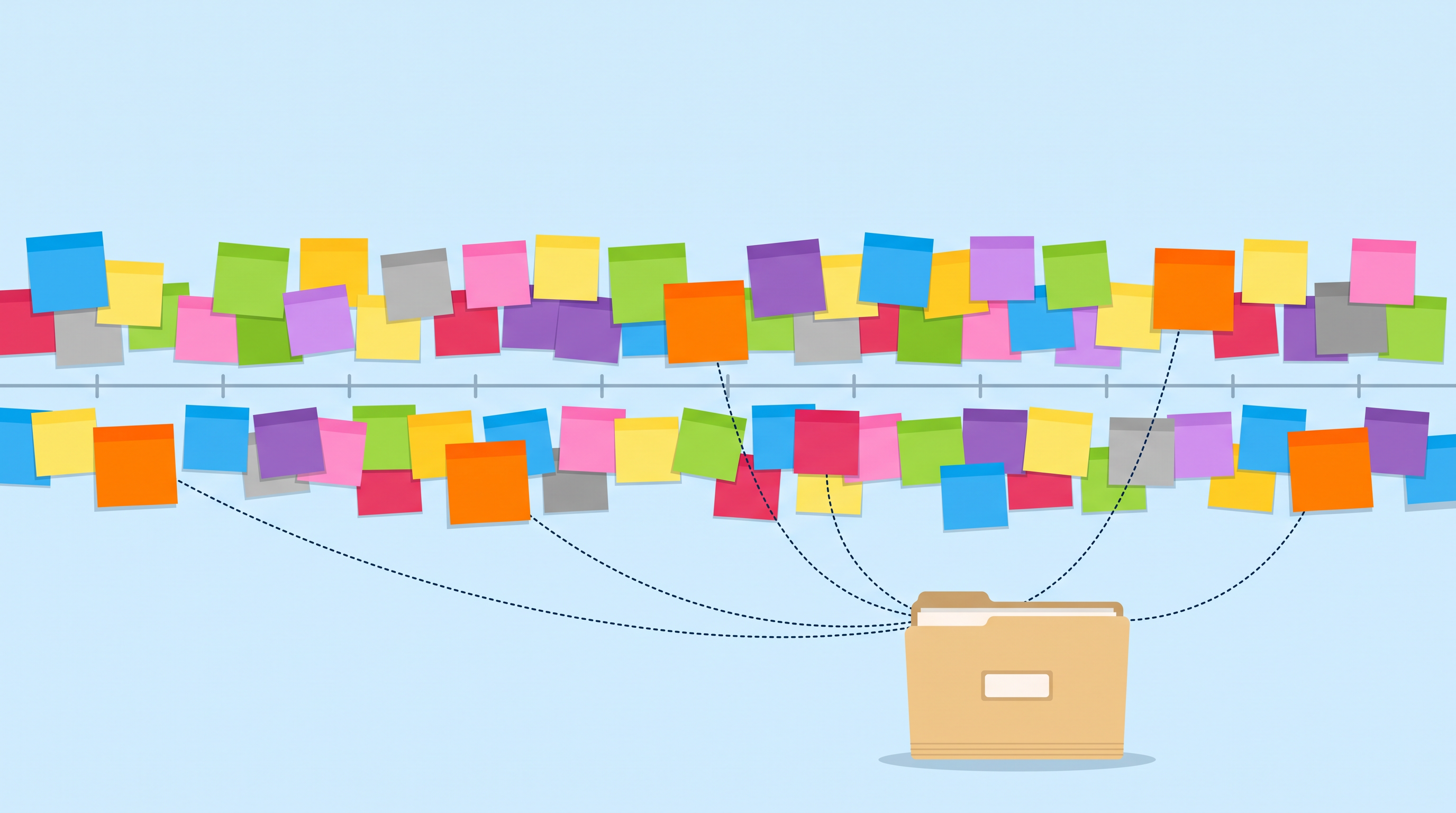
A long horizontal timeline of mixed sticky notes in many colors, with a few notes of the same bright orange color scattered far apart along the line, connected by thin dotted threads pulling them together toward a single folder, flat illustration, no text
Capture Then File: Two Modes, Two Moments
The mistake almost everyone makes (me included, for years) is trying to capture and organize in the same moment. At 4am you are in no state to decide which folder something goes in, what tag to add, or whether this is really a new project or part of an old one. So you either skip the decision and dump it in the inbox, or you skip the capture entirely because the friction is too high.
Think of it like a mail slot. Letters drop through the slot whenever they arrive. You don't stand at the door sorting them as they fall. You collect them, and later, when you have a minute, you sort them at the kitchen table.
So the method splits into two modes that never happen at the same time:
Mode 1: Capture. Instant and decision-free. One inbox. No folders, no tags, no titles, no rewriting. The only rule is speed: if capturing takes more than 10 seconds, the system is broken. You're preserving a fragment, not processing it.
Mode 2: File. Later, when you're awake, caffeinated and sitting still. You open the inbox and, for each fragment, ask one question: "which project is this for?" Then you move it into that project's note.
But here's the trick: the project note isn't a folder. It's a single growing document. Every fragment gets appended to it under a small heading. Over weeks, that document quietly turns into something that looks a lot like a plan. You never sat down to "plan the project". You just filed fragments twice a week and the project assembled itself.
The Method, Step by Step
Here's exactly how I run it. Adjust the timings to your life, but keep the separation between the two modes sacred.
- Pick one capture inbox. One. It should be the thing you can reach fastest at 4am, in the car, in the shower (a voice memo counts). If you have three inboxes you'll spend your filing time hunting for fragments instead of filing them.
- Capture raw. Don't polish the sentence, don't add context you'll "definitely remember", don't title it. Write just enough that future-you can decode it. "Timer, unlock next session with one sentence" is plenty.
- Schedule two filing sessions a week. Mine are Tuesday and Friday, 10 minutes, first coffee. Put it in your calendar. Filing that isn't scheduled doesn't happen.
- For each fragment, ask one question: which project is this for? There are exactly three answers: an existing project note, a brand new project note, or the trash. No fourth option, no "I'll decide later" pile.
- Append it to the project note under a heading. I use five: Core idea, Features, Names, Doubts, Next step. Add the date in front of the fragment so you can see how the thinking evolved.
- Watch for graduation. When a project note has a one-sentence pitch, at least three features, and one doubt with an answer written under it, it stops being an idea and becomes a project. Write the first real task and move it to your task manager.
Quick tip: during filing, read the whole project note before appending the new fragment. This takes 30 seconds and it's where most of the magic happens. You'll notice a fragment from three weeks ago answers a doubt from last week, or two features are actually the same feature. Filing is disguised thinking time.
What a Project Note Looks Like After a Month
Let me show you the timer idea from the intro, as it sat in my project note after four weeks of filing. Nothing here was written in a "planning session". Every line arrived as a scattered fragment and got appended in under a minute.
PROJECT: Sentence Timer

## Core idea
- Mar 3  Focus timer that only unlocks the next session if you write one sentence about what you just did
- Mar 12 Reframe: it's a work journal disguised as a timer, the timer is the hook

## Features
- Mar 8  Sentences roll up into a weekly log
- Mar 15 Export weekly log as plain text for standups
- Mar 21 Streak based on sessions with a sentence, not sessions started

## Names
- Mar 10 "One Line"
- Mar 19 "Sentence Timer" (boring but clear, probably wins)

## Doubts
- Mar 17 Would anyone pay for this? Pomodoro apps are free
- Mar 24 Answer: the paid part isn't the timer, it's the log + export. Freelancers already pay for time tracking

## Next step
- Mar 24 Build a 3-screen prototype: timer, sentence input, weekly log. Nothing else
Look at that for a second. There's a pitch, a clear feature set, a name, a market doubt and an answer to it, and a scoped first step. That's a plan. And the doubt from March 17 was answered by a fragment on March 24 that only made sense because I could see the doubt sitting right above it when I filed.
In a chronological system those two thoughts would have been 30 notes apart. I probably wouldn't have connected them at all.

Objections I Hear (And Had Myself)
"Filing sounds like a chore." I get that. It sounds like admin. In practice it's 10 minutes twice a week, and it's the most pleasant part of my week because I'm rereading my own best thoughts with fresh eyes. After a month you'll start looking forward to it. Don't get me wrong, the first two sessions feel awkward. Push through.
"What if I don't know which project a fragment belongs to?" Then it's a new project, and the fragment becomes its first line. Yes, this means you'll spawn a lot of one-line project notes. About 60% of mine never get a second fragment. That's fine. That's not clutter, that's data: the idea didn't have enough pull to generate a second thought.
"Won't I end up with 40 project notes?" Probably. I have around 30 active at any time. The rule that keeps it sane: any project note that hasn't received a fragment in 60 days gets archived. Not deleted, archived. Ideas come back. But they don't get to sit in the active list taking up attention.
"Can't I just use tags?" You can, and I did for a year. The problem is tags still leave you with fragments as separate items that you have to mentally reassemble every time. The whole point of the growing project note is that the assembly is done once, on the page, and stays done.
The App I Built Around This
I said this wasn't an app review and I meant it. The method above works in Apple Notes, Obsidian, a Moleskine, or a text file. I ran it in plain text files for over a year.
But I'll be honest about one thing: I got tired of the friction between the two modes. Every tool I tried was either great at fast capture and bad at filing, or great at structured notes and terrible at 4am. So I built ChatNote around this exact split. Capture feels like sending yourself a text message: open, type, done, no decisions. Then, when you sit down to file, each message gets dragged into a growing project note in a couple of taps. It's the tool I use every single day, and it exists purely because I wanted the capture-then-file method with less glue.
If you try it, great. If you run the method in your own setup, also great. The tool matters far less than the separation.
Start This Week
Here's the whole thing in three lines: ideas arrive as fragments, chronological notes scatter them, and filing each fragment into a growing project note lets the project assemble itself.
Your next steps, in order:
- Tonight: pick your one capture inbox and delete or ignore the others.
- Tomorrow morning: open your existing notes from the last month and sort them into project notes. It'll take 20 minutes and it will be uncomfortable and eye-opening.
- This week: put two 10-minute filing sessions on your calendar.
- In 30 days: look at your project notes and pick the one closest to graduation. Build that.
After 3 months of this you'll have a handful of project notes that read like briefs you never consciously wrote. That's the payoff. Your scattered thinking wasn't the problem. It just needed a place to land.
I'm curious what your version of the 4am fragment looks like, and how many of them you think you've lost to a chronological inbox. Tell me in the comments, and if you already run something like this, I'd genuinely love to hear what your project note headings are.
Also available in

Pablo Dominguez
Full Stack Developer passionate about building interesting projects and learning new skills.