
For about two years I had a party trick nobody asked for. I could sing my alto line flawlessly in the car. Flawlessly in the shower. Flawlessly in rehearsal when the director played it alone on the piano and everyone else sat quietly. Then the sopranos came in on the melody and I was gone. Not slightly off. Gone. Two bars later I'd realise I was singing the tune an octave down and pretending it was harmony.
Sounds familiar? If you sing in a choir, do backing vocals, or record your own harmonies late at night with a laptop and a cheap mic, you've almost certainly lived this. And the frustrating part is that you can hear when it's right. You just can't seem to hold it when another voice is pulling at you.
So this post is my attempt to answer the question I typed into a search bar far too many times: how can I practice singing harmony by myself? We'll cover why it's hard (it's not you, it's your ear), what a third, a fifth and an octave actually are, the one trick that finally made it click for me, and a slightly nerdy detour into why most pitch apps are tuned a little wrong for this job. Then a routine you can start tonight.
Why Holding a Harmony Line Alone Is So Hard
Here's the uncomfortable truth: your ear is wired to follow the melody. Not because you're a weak singer, but because the melody is the loudest, most familiar and most repeated thing in the room. It's the line everyone hums on the way home. Your brain files it as "the song" and files your harmony part as "a variation of the song."
When you rehearse your part alone, there's nothing competing for that slot in your head. Your line becomes the melody for those five minutes. Then the real melody arrives, louder, sung by more people, and your brain politely hands the wheel over to it. That's the drift. You don't decide to go to the melody. You get pulled there.
There's a second problem hiding underneath the first one. Most of us practice harmony by singing against nothing. We hum our line in the kitchen with no reference at all. That trains you to hold a shape, sure, but it never trains the actual skill you need on stage: staying on your note while a different note is happening right next to you.
Practicing harmony alone with no reference is like practicing goalkeeping with no ball. You're moving, but nothing is testing you.
I get that this sounds discouraging. It shouldn't be. Once you understand that the problem is the missing reference, the fix becomes obvious, and we'll get to it in a minute. First, a quick tour of what you're actually singing when someone says "you're on the third."
Thirds, Fifths and Octaves, Explained Without the Theory Lecture
Every harmony part is described by its distance from another note. That distance is called an interval. For most choir and backing vocal work, three intervals do almost all the heavy lifting.
The octave. Same note name, higher up. If the bottom voice sings a C, the octave is the next C above it. Men and women singing "the same" melody are usually singing in octaves. It sounds like one thickened voice rather than two separate ones, which is exactly why it's the easiest to hold and the best place to start.
The fifth. Count up five letter names from the bottom note, including the one you start on. From C, that's C, D, E, F, G. So the fifth above C is G. It sounds open, strong, a little hollow on its own. Think of the first two notes of the Star Wars theme, or a bagpipe drone. Fifths are stable and forgiving, which makes them the natural second step.
The third. Count up three: C, D, E. The third above C is E. This is the interval that makes harmony sound sweet. It's also the one that gives everyone trouble, for two reasons. It sits close to the melody, so it's easy to slide onto the tune by accident. And, as you'll see in the next section, a truly in-tune third is not where the piano says it is.
Quick tip: if you're ever handed a part and told "just sing a third above," you can find it by singing the bottom note, then the first three notes of a major scale from it (do, re, mi). "Mi" is your third. Do the same to "sol" and you've got the fifth. It's a cheap trick but it works in a pinch.
The Trick: Record the Bottom Line, Then Sing Over It
Now, let's talk about the thing that actually fixed my drifting problem.
But here's the trick: stop practicing against silence and start practicing against yourself. Record the bottom line first. Just the lowest part, on a simple vowel, a few notes long. Then play it back and sing your harmony over the top of it while it plays.
Why does this work so much better than humming in the kitchen? Because now you have a fixed reference. The recording doesn't waver, doesn't get nervous, doesn't speed up when the conductor glares. It sits there, exactly the same every time, and your job is to plant your note next to it and not move. That's the skill. That's the whole skill.
There's a bonus that took me a while to notice. When you record the bottom part yourself, you've now sung both parts. Your body knows where the low note lives, and it knows where the high note lives, and it knows the gap between them. After a couple of weeks you start to feel the interval as a physical distance rather than a note you're hunting for. That's when the drifting stops.
You can do this with any voice memo app and a bit of patience. The rough workflow is: record, play, sing, judge by ear, repeat. It works. It's also a little clunky, and the "judge by ear" step is exactly where beginners struggle, because if your ear could reliably tell you when the third was right, you wouldn't be reading this. Which brings us to the part most pitch apps get subtly wrong.
Equal Temperament vs Just Intonation, or Why Your Pitch App Is Slightly Wrong for Harmony
This is the nerdy detour I promised. Stick with me, because it explains a feeling you've definitely had: the moment a choir "locks" and the room seems to ring.
A piano is tuned in equal temperament. The octave is chopped into twelve steps of exactly the same size, so that every key sounds equally decent. It's a brilliant compromise. It lets one instrument play in C major and then F sharp minor without retuning. But it is a compromise, and the thing being compromised is the purity of the intervals.
Just intonation is what happens when you tune intervals by simple frequency ratios instead. A pure octave is 2 to 1. A pure fifth is 3 to 2. A pure major third is 5 to 4. When two notes sit in those exact ratios, their overtones line up, the beating disappears, and the sound goes smooth and bright. That's the ring. That's what a barbershop quartet or a good chamber choir is doing when the chord seems to hang in the air.
So how far apart are the two systems? Musicians measure this in cents, where 100 cents is one piano semitone. The octave matches perfectly in both systems, so no problem there. The fifth is close: the pure fifth is about 2 cents wider than the piano's, which almost nobody can hear. The major third is the troublemaker. A pure major third is roughly 14 cents narrower than the piano's third. Fourteen cents is small, but it's absolutely audible when two voices hold a chord. (Minor thirds go the other way, sitting a touch wider than the piano's, which is why they're their own special headache.)
Here's why this matters for you. Almost every tuner and pitch app on your phone judges you against the piano's equal-tempered note. So if you sing a truly pure third above your recorded bottom line, the kind that makes a choir lock, the app will tell you you're 14 cents flat. And if you "fix" it to make the app happy, the chord will lose its ring. You'd be training yourself, very precisely, to be slightly wrong for harmony.
Don't get me wrong, a standard tuner is great for melody, for scales, for warm-ups. For harmony, you need something that knows which interval you're aiming for and judges the relationship between the two voices, not just whether each note sits on a piano key.
How Scalita's Harmony Training Handles This
I ended up using Scalita for this, and I want to describe it honestly rather than sell it, because the workflow is exactly the record-and-sing-over trick above, just with the annoying parts removed.
Harmony training lives on the Practice tab as the third mode down, under Find My Warmup and Adaptive Mode, and above Pitch targeting. The one-line description under it says it all: "Sing a line, then sing over it."
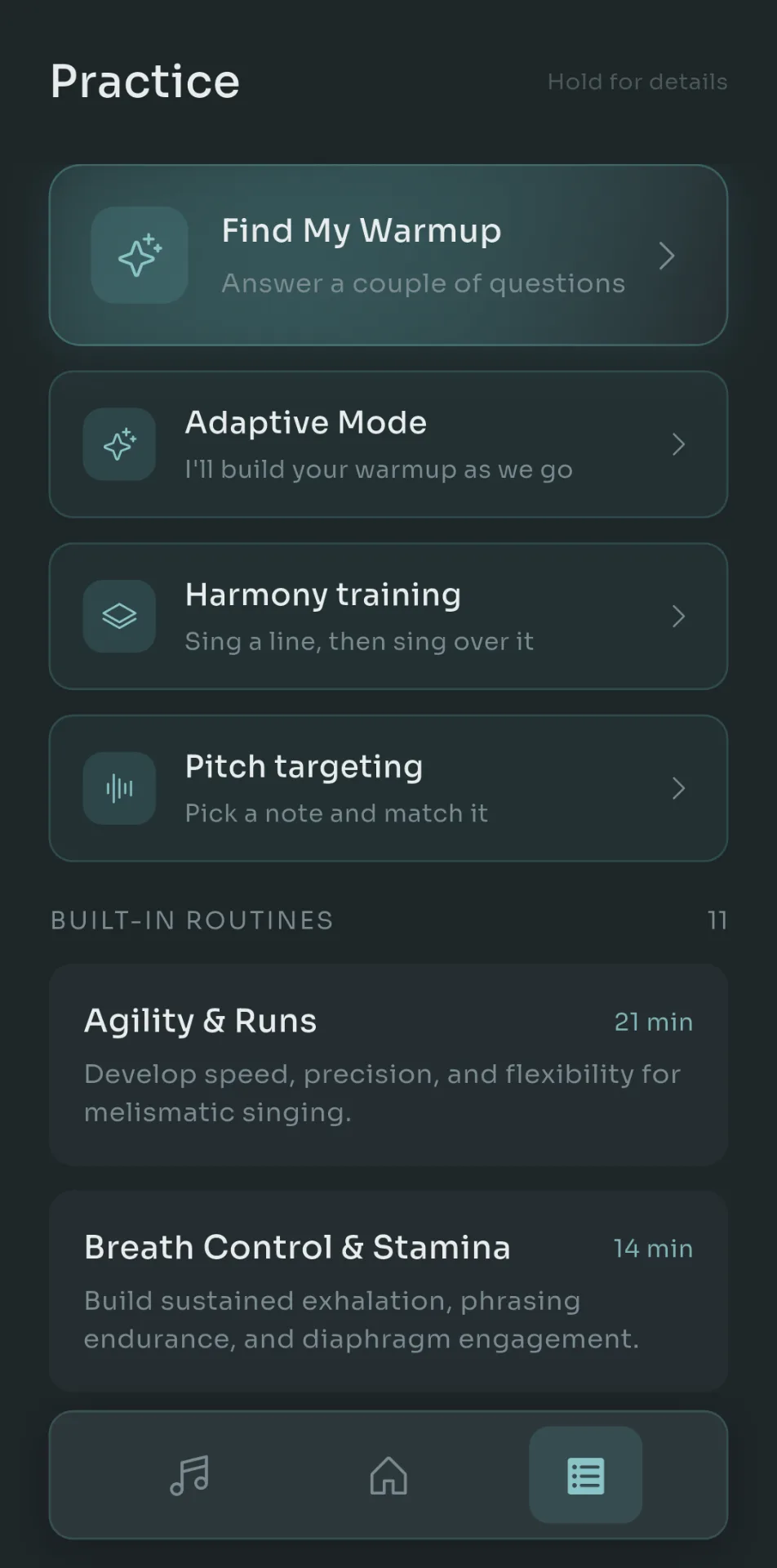
Scalita Practice tab showing Find My Warmup, Adaptive Mode, Harmony training and Pitch targeting modes, with built-in routines listed below
The flow goes like this. You record one line, the bottom voice. Then you tell the app which part you're about to sing over it: a third, a fifth or an octave above the bottom voice. You sing the second part while the first plays back, and then you hear them together. You can keep stacking, up to four parts, all of them yours.
The part that made me switch from voice memos is the judging. Because you've told it you're aiming for a third, it doesn't just check whether you held something steady. It checks whether you landed the third you were aiming for, and it measures that against just intonation, not against the nearest piano key. So the pure, locked-in third that a standard tuner calls flat is the one Scalita calls right. That's the whole point of the previous section made practical.
Here's what a finished one looks like. This is a short exercise I called "Evening Thirds," twelve seconds long, four parts.
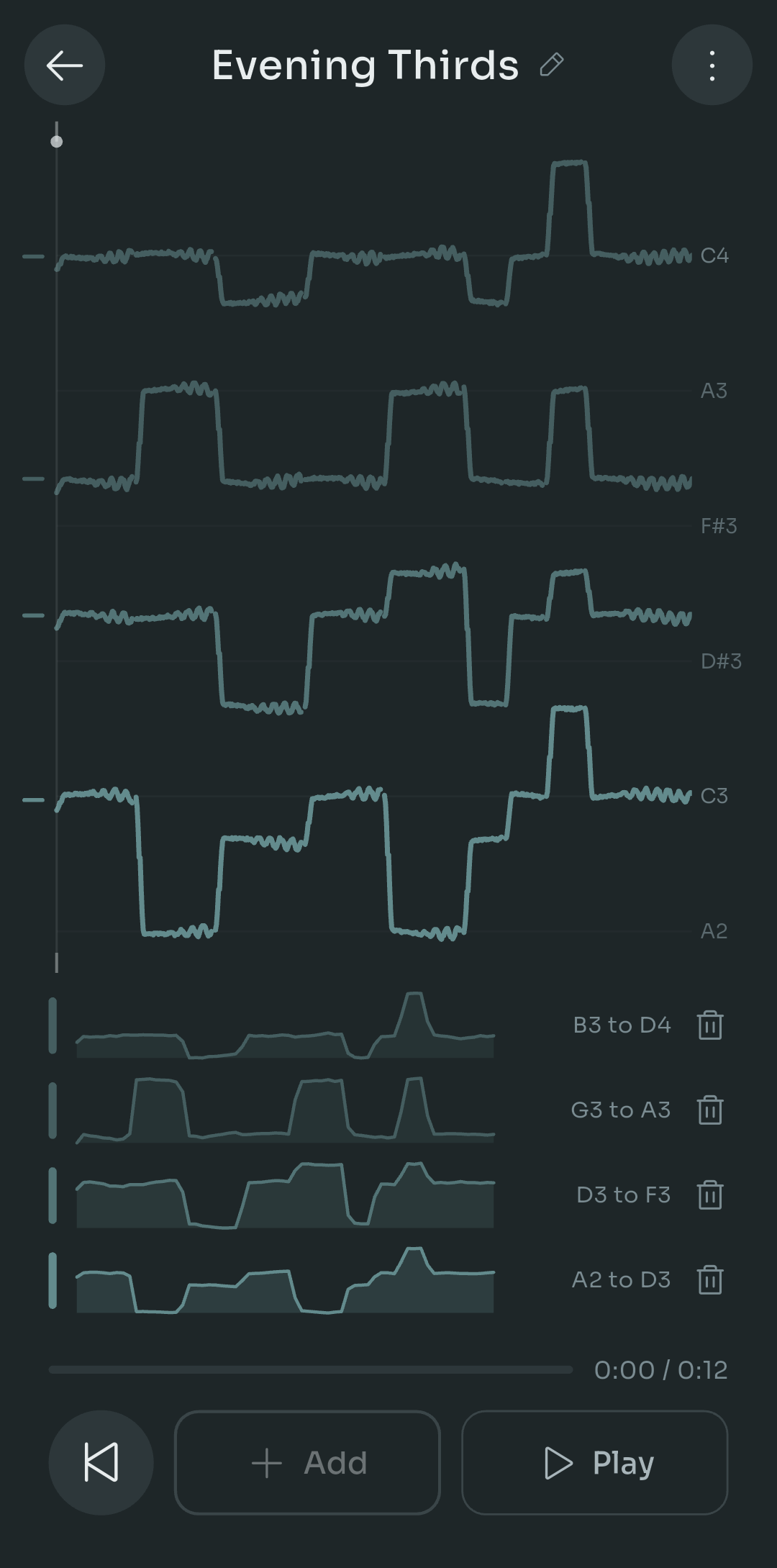
Scalita harmony screen titled Evening Thirds showing four stacked pitch traces with note labels from A2 to C4, and four recorded takes listed below with their note ranges
The main area is four stacked pitch traces, one per part, drawn over the same twelve seconds. Note names run down the right side (C4, A3, F sharp 3, D sharp 3, C3, A2) so you can see roughly where each voice sits. You can see the top line hovering around C4 with a jump near the end, the second part stepping between two notes around A3, and the bottom part living down around C3 and dipping to A2. The little wobbles in each line are just vibrato and the natural shake of a real voice. They're not errors.
Underneath, the four takes are listed as separate strips, each with its own tiny waveform and the note range it covered: B3 to D4, G3 to A3, D3 to F3, and A2 to D3 for the bottom voice. Each has a delete icon, so if one part is off you can bin just that take and re-record it without touching the others. At the bottom there's a scrubber, an Add button for the next part, and Play to hear the stack.
Looking at those strips is weirdly useful. Seeing that your "third" part spans G3 to A3 while the bottom is A2 to D3 tells you instantly whether you sang the interval you meant to or wandered somewhere else. It's the visual version of the physical-distance feeling I mentioned earlier.
One small thing I didn't expect to like: when the harmony comes together and the app agrees it sounds right, it makes a picture of the finished harmony you can share. It's basically a snapshot of those stacked traces. I've sent a few to friends in my section as a "look, I finally held the alto against the melody" flex. Silly, but it kept me practicing.
A Practice Routine You Can Actually Stick To
Knowing the theory is nice. What changed my singing was doing the same boring thing for ten minutes a day. Here's the routine, whether you use Scalita or a voice memo app and a lot of patience.
- Step 1: Start with octaves for the first week or two. Record a bottom line of four to six notes. Sing the octave above. It'll feel almost too easy. Good. You're teaching your ear what "locked" sounds like before the hard intervals show up.
- Step 2: Move to fifths. Same bottom line, same length. Fifths are stable and only a hair off from the piano, so you get the reward of a ringing sound without fighting your tuner instinct.
- Step 3: Then thirds. This is where the drift lives, so expect a rough first few days. Aim for the sweet, ringing version rather than the bright piano version, and trust the just-intonation judgement over your old tuner habits.
- Step 4: Record the bottom part on a syllable, not words. Use "noo," "ah" or "doo." Words drag your attention to lyrics and rhythm, and different vowels tune differently. One vowel keeps the whole exercise about pitch.
- Step 5: Keep phrases short. Three to five notes, eight to twelve seconds. Short phrases mean more repetitions, and repetitions are what build the physical sense of the interval.
- Step 6: Compare takes week to week. Save one harmony, then rebuild the same exercise a week later and listen to both. Progress in harmony is slow and quiet, and hearing last week's version is often the only way you'll notice it.
Quick tip: once thirds feel stable, add a third part and try singing a fifth above the bottom while the recorded third plays too. That's a full triad, all you, and it's the closest thing to a real choir chord you can make alone in your flat.
After about three weeks of this I went back to rehearsal, the sopranos came in, and for the first time I just... stayed. Nothing dramatic. I simply didn't move. That's what this training feels like when it works: not a triumph, more like a thing that used to be hard quietly stopping being hard.
What It Costs and Where to Get It
Scalita is Android only for now and free to download. The free tier lets you use harmony training fully, with one catch: it keeps one saved harmony at a time. You can always build a new one in full and keep that instead, so it doesn't stop you practicing, it just stops you hoarding.
Pro lifts that cap so you can keep a library of takes to compare week to week, which is honestly where Step 6 of the routine gets much easier. It's a one-time purchase of $4.99, not a subscription. The app comes in five languages.
If you're on iPhone, the record-the-bottom-line trick still works with any voice memo app. You'll just be judging by ear, and you'll want to remember that your standard tuner wants a third that's about 14 cents too wide for a locked chord.
Wrapping Up
Let me pull the whole thing together into the version I wish someone had handed me two years ago.
You lose your part because your ear follows the melody, and practicing against silence never trains you to resist that pull. Octaves, fifths and thirds are the three distances that cover most harmony work, in that order of difficulty. Record the bottom line and sing over it so you're always training against a fixed reference. And remember that a pure vocal third is not the piano's third, so if your app judges you against equal temperament, it's nudging you away from the sound a locked choir makes.
Then just do the routine. Octaves, fifths, thirds. Syllables, not words. Short phrases. Compare week to week. Ten minutes a day is plenty.
If you've got a trick that helped you hold your line against the melody, or a harmony exercise you swear by, tell me in the comments. I'm still an alto who occasionally gets pulled to the tune, and I'll take every trick I can get.

Pablo Dominguez
Full Stack Developer passionate about building interesting projects and learning new skills.