
The Sound You Can Make But Can't Train
A while back I spent about forty minutes in my car trying to reproduce a whistle note I'd hit by accident the day before. I got it twice. Both times I had no idea what I did differently. Sounds familiar?
That's the strange place a lot of us end up with the extreme ends of the voice. You've watched the YouTube videos. You understand roughly what subharmonics, flageolet and whistle register are. You can sometimes produce the sound. And then you open your warmup app and there is nothing there. Not a single exercise that lives in those ranges. Not even a way to tell the app those notes exist.
So you're stuck practicing by accident, which isn't practicing at all.
This post fixes that in two parts. First I want to teach the three registers carefully, because most of the frustration comes from treating them like "more" of what you already do. Then I'll show you how I actually train them with Scalita, including a weekly plan that won't wreck your voice.
What These Three Registers Actually Are
Let's start with the map you already know. Chest voice is where you speak and belt. Head voice sits above it, lighter and thinner. Most singers, most teachers and almost every app treat those two as the whole voice.
They aren't. There's territory below chest and territory above head, and the three registers we're talking about live out there.
Subharmonics: the rattle under chest voice
A subharmonic is a note that sounds an octave (or sometimes more) below what your vocal folds are actually doing. Your folds keep vibrating at, say, an A2. But something above them, usually the false folds, starts closing on every other cycle. The result is a repeating pattern that's twice as long, and your ear hears that as an octave lower: a rattling A1.
That's why it feels like a trick. You're not producing a low note. You're producing a normal note and adding a rhythmic interruption on top of it. If you've ever done a vocal fry that suddenly locked into a stable pitch, you've been close.
Key point: subharmonics are not extended chest voice. Pushing your chest voice lower gets you a weaker, breathier chest voice. The rattle comes from a different mechanism entirely.
Flageolet: the thin flute above head voice
Flageolet is the thin, flute-like tone that sits above head voice. In head voice your folds are stretched and only the edges vibrate. In flageolet the folds get even thinner, and a smaller portion of their length is doing the work. The sound loses most of its body and turns into something closer to a recorder or a piccolo.
For most voices this lives somewhere between roughly F5 and C7, though the exact span varies a lot. Some people slide into it from head voice without noticing. Others hit a wall around C6 and can't understand why more effort makes things worse (we'll get to that).
Whistle: the very top
Whistle register is above flageolet. Here the folds are nearly closed with only a tiny opening, and the sound is produced more like an actual whistle than like vibration. It's piercing, narrow and surprisingly quiet in the throat while being very loud in the room.
Think roughly C7 and up, again depending on the voice. It's the register people chase because of Mariah Carey and Minnie Riperton, and it's also the one that's most sensitive to tension. Squeeze, and it disappears.
Why "Just Push Higher" Fails
Here's the mistake I made for years. I assumed that high notes were the result of more: more air, more support, more effort. That works up to a point in chest voice. It's the exact opposite of what flageolet and whistle need.
Both of those registers require less mass and less air. The folds have to get thinner and the opening smaller. Pushing does two things: it adds pressure that blows the tiny opening apart, and it recruits muscle that thickens the folds. So every time you push, you're actively destroying the setup you need.
Subharmonics have the mirror problem. People try to force chest voice lower and end up with a weak, unstable bottom. The rattle needs a relaxed, steady chest note and a very specific engagement above the folds. Force kills it.
That's also why these registers feel so different from singing. They aren't singing harder or softer. They're a different physical configuration, and you have to find the configuration rather than muscle your way into it.
You don't reach a whistle note. You allow it. The moment you try to grab it, it's gone.- A note I wrote after the fortieth failed attempt
The Safety Rules Nobody Repeats Enough
I get that safety talk is boring. But these registers put your folds in unusual positions, and the cost of doing it wrong is measured in days of hoarseness. So, the rules I actually follow:
- Never with pain. Not "a little" pain. None. Tickle and mild fatigue are normal, sharp or scratchy sensations are a stop sign.
- Warmed up first. Extreme registers come after a full general warmup, never as the first thing you do.
- Short sessions. Five to twelve minutes of extreme register work is plenty. More than that and the returns go negative.
- Stop when it stops working. If the sound was there and then vanishes, you're done for the day. Chasing it back is how people hurt themselves.
- Hydrate and rest. Boring, true, and the reason your Tuesday session goes better than your Monday one.
One more: if you have any history of vocal injury, talk to a voice professional before you start experimenting with subharmonics or whistle. This post is what I do, not medical advice.
Why Almost No Warmup App Helps
Now, let's talk about the tooling problem, because it's the real reason you're practicing by accident.
Open any popular warmup app and set your range. The slider goes from roughly a low bass note to roughly a high soprano note and stops. The app thinks of your voice as chest plus head, and that's it. There's no concept of a register below chest or above head. You literally cannot enter a whistle range, so there's nowhere for a whistle exercise to live even if the developers wanted to write one.
And even if you could, the exercises themselves are wrong for the job. A standard five-note scale at 80 bpm assumes you can move between notes freely. In a subharmonic, moving is the hard part. Holding is the point. You need exercises designed around entering and sustaining a register, not exercises that assume you're already in it.
Then there's the reference tone. Most apps use a synthesized piano. At C4, fine. At C7, a synth tone is a thin electronic beep that gives your ear nothing to lock onto. You can't match what you can't hear properly.
So you end up on YouTube, replaying a ten-second clip, guessing. That's the gap.
How Scalita Handles the Extra Registers
Full disclosure: I use Scalita daily and I'm going to describe it in some detail because it's the only warmup app I've found that treats these registers as real places rather than rounding errors. It's Android only, free to use, and the Pro upgrade is a one-time $4.99 (no subscription). It's available in five languages.
The core idea is simple. Instead of one range, you set a separate span for each extra register you actually use: subharmonic, flageolet and whistle. If you don't use one, you leave it empty and nothing else in the app changes.
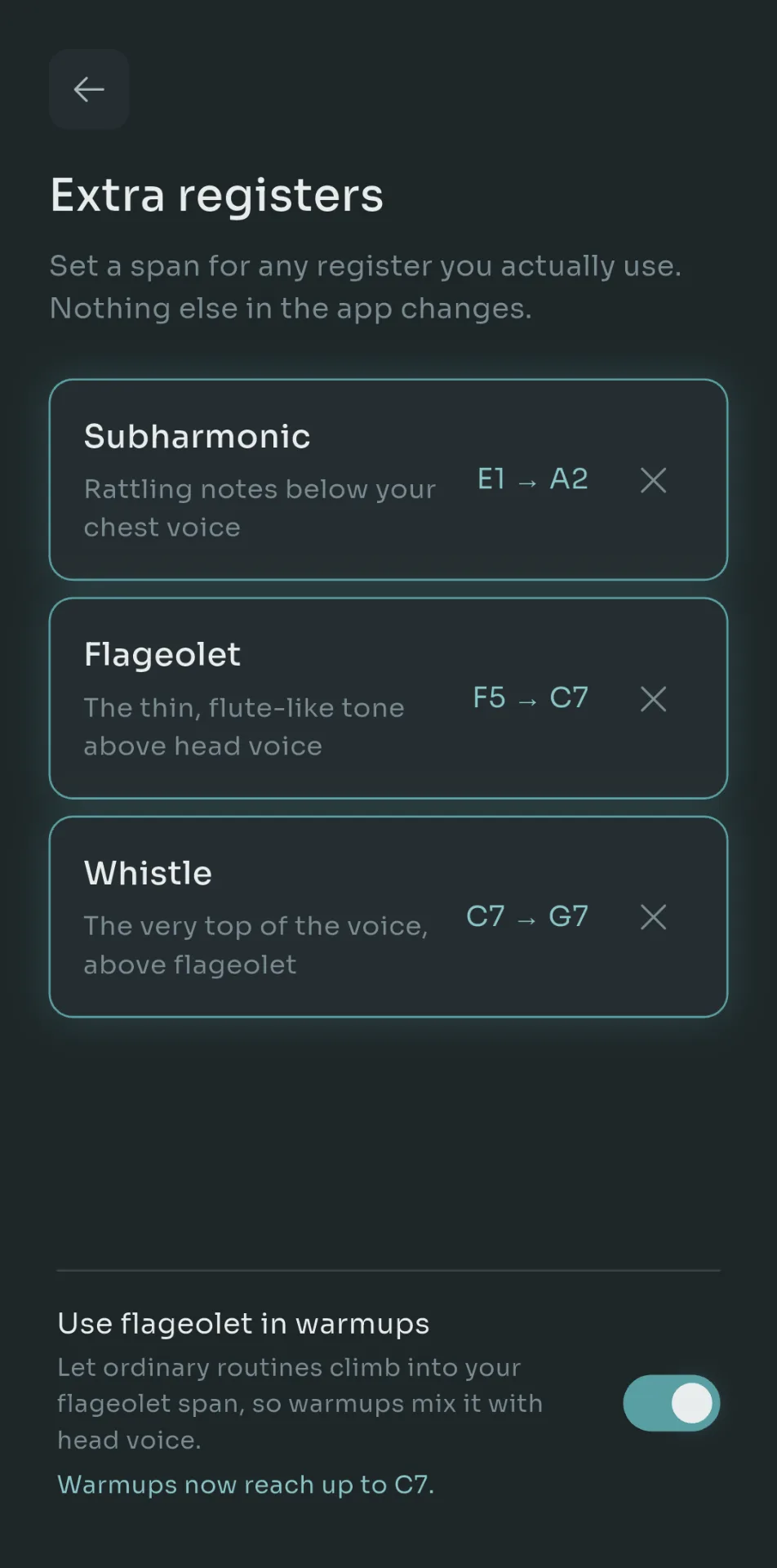
Scalita Extra registers screen showing subharmonic E1 to A2, flageolet F5 to C7, whistle C7 to G7, with a toggle to use flageolet in warmups
That's my current setup: subharmonic from E1 to A2, flageolet from F5 to C7, whistle from C7 to G7. Yours will look different, and that's fine. The point is that the app now knows those notes exist for you.
Notice the toggle at the bottom, Use flageolet in warmups. With it on, ordinary routines are allowed to climb into your flageolet span instead of stopping at head voice. The app tells you plainly what that means: warmups now reach up to C7. So a regular descending scale might start in flageolet and settle into head voice, which is exactly the kind of transition you need to smooth out. I keep it on most days and turn it off when I'm tired.
But here's the trick: setting a register span unlocks a dedicated routine built to get you into that register. Set subharmonic and you get the Subharmonic Warmup. Set flageolet and you get the Flageolet Bridge. Set whistle and you get the whistle routine. They show up in Quick access on the home screen alongside the normal stuff.
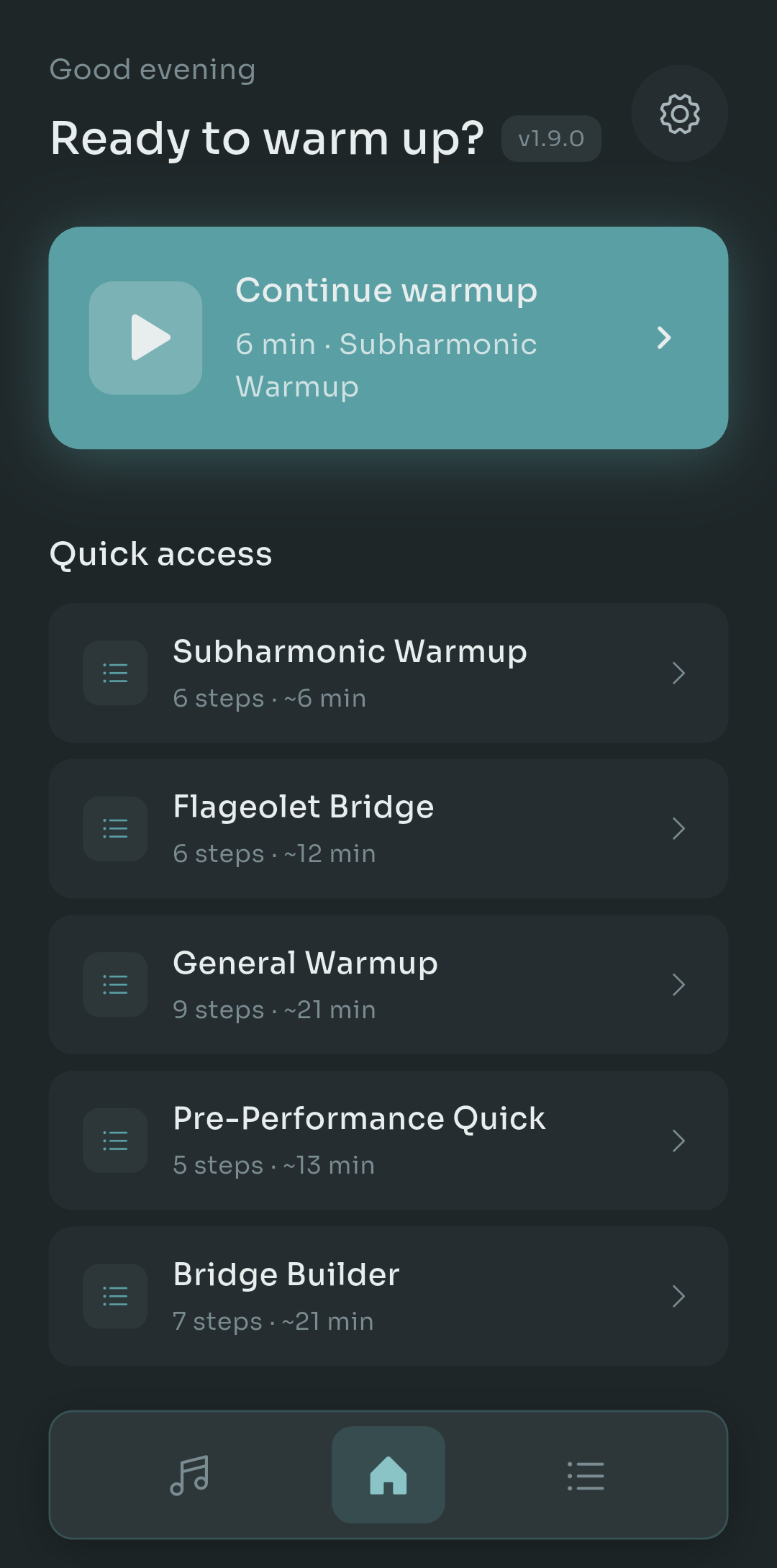
Scalita home screen with Subharmonic Warmup and Flageolet Bridge in Quick access next to General Warmup, Pre-Performance Quick and Bridge Builder
You can see them sitting there: Subharmonic Warmup at six steps and about six minutes, Flageolet Bridge at six steps and about twelve minutes, right next to the General Warmup I do every day. The extreme register work becomes a normal part of the day instead of a separate ritual.
What the Subharmonic Warmup actually does
This routine is short on purpose and it stays on a couple of notes on purpose. The description in the app says it directly: find the rattle under your chest voice and keep it steady. Two cues apply to the whole routine, Drone, not drill and Steady support.
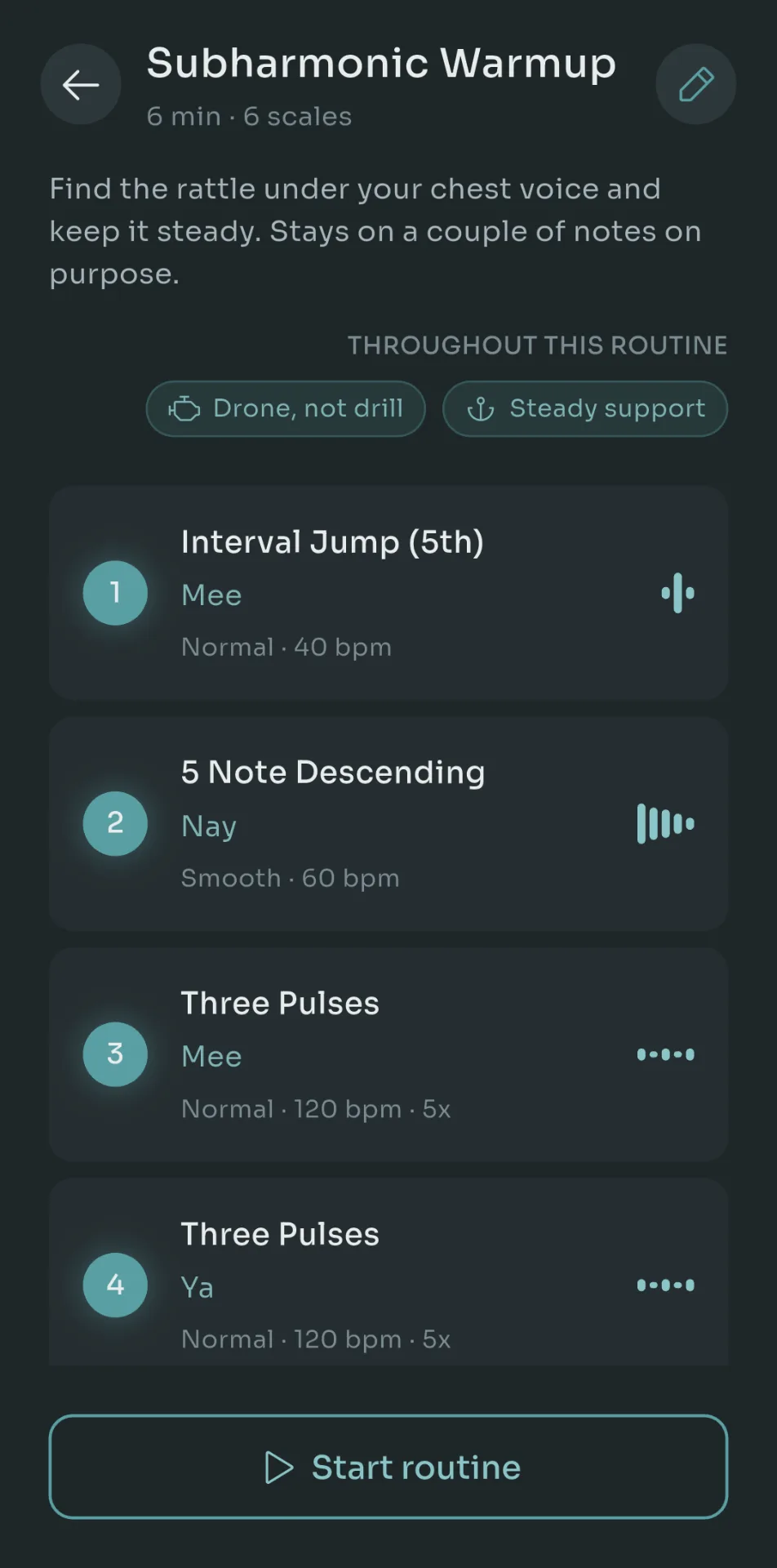
Subharmonic Warmup routine overview in Scalita with the cues Drone not drill and Steady support, followed by six steps including Interval Jump, 5 Note Descending and Three Pulses
"Drone, not drill" is the whole philosophy. Regular warmups drill: you run patterns, you move. Subharmonics want you to drone: sit on a note, let the rattle settle, hold it. That's why the first step is a single interval jump at a slow 40 bpm on Mee, and why the later steps are three pulses on the same note, repeated, rather than scales that wander around.
Mid-exercise, the cues open up further. The vowel cue for Mee is to hum into a bright Ee, forward resonance, clear tone, relaxed and speech-like. That brightness matters: a dark, swallowed vowel adds weight, and weight kills the rattle.
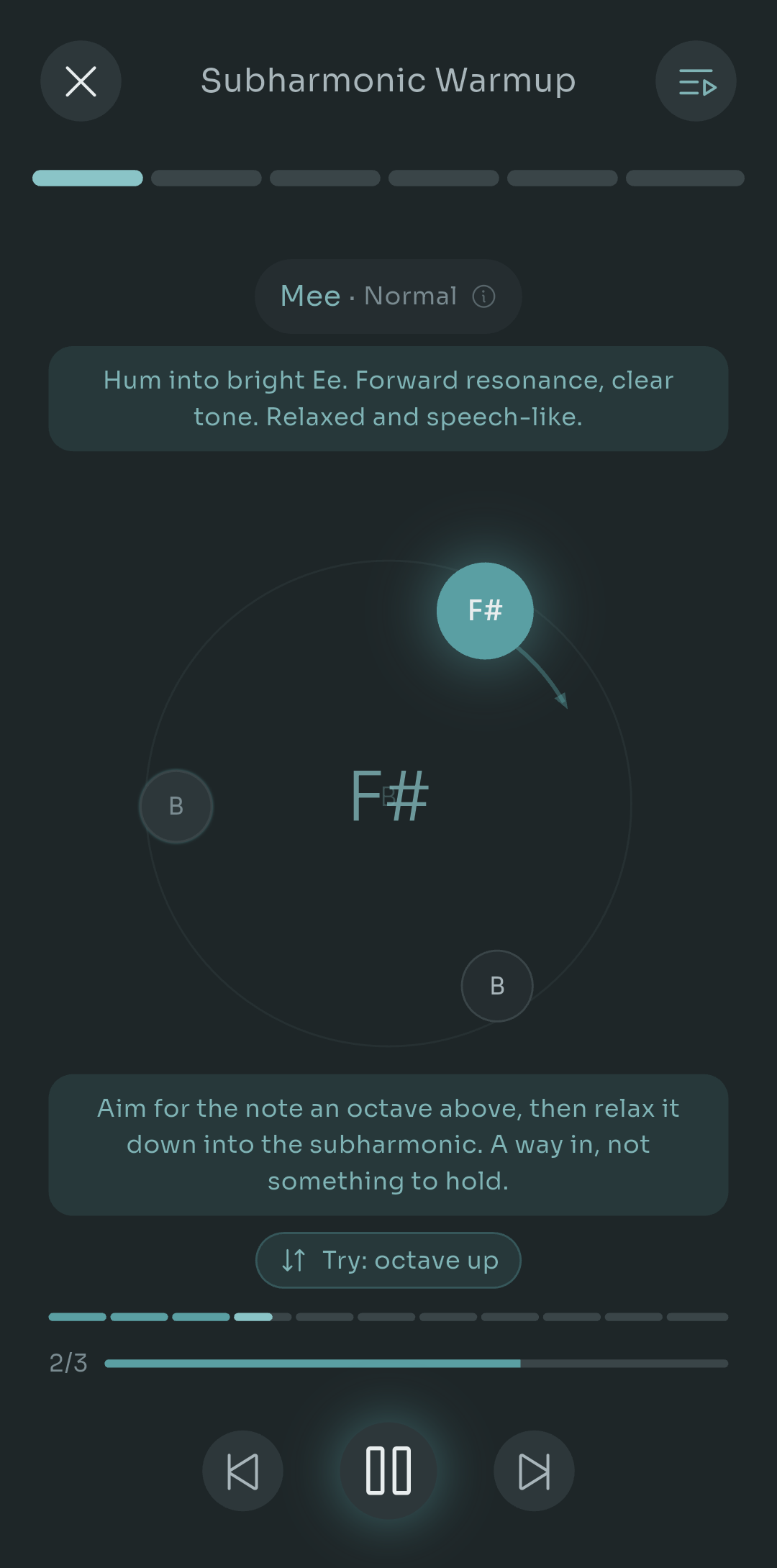
Scalita mid-exercise screen on F sharp during the Subharmonic Warmup, with the cue to aim for the note an octave above and relax into the subharmonic, and a Try octave up suggestion
Look at the cue at the bottom of that screen: aim for the note an octave above, then relax it down into the subharmonic. The app calls it a way in, not something to hold. That single instruction unlocked subharmonics for me after months of fumbling. You sing the normal note your folds are meant to produce, keep it steady, and let the rattle drop in underneath. If it's not locking, there's a one-tap Try: octave up button that shifts the target so you can approach it from the note you can actually sing.
The Flageolet Bridge and the whistle routine
The Flageolet Bridge works from the opposite direction. It starts in comfortable head voice and thins out gradually, spending most of its twelve minutes right at the seam where head voice hands over to flageolet. The goal isn't to reach C7. The goal is to make that handover boring. Once it's boring, the top takes care of itself.
The whistle routine is the shortest of the three and the most conservative. Very small ranges, long rests between attempts, and cues that keep repeating the same message: less air, less effort, allow rather than reach. If you find yourself straining during it, you're doing it wrong, and the routine is designed to make that obvious.
Quick tip: the piano in Scalita has a real sample on every key from A0 to C8. I mentioned earlier why this matters. When you're trying to match a C7, a sampled piano gives you the attack, the overtones and the decay of a real string, and your ear knows what to do with that. A synth tone at C7 is a beep. I genuinely couldn't train whistle until I had a reference I could hear.
A Weekly Plan That Won't Wreck Your Voice
Here's the structure I've settled on after a few months. The general principle: one extreme register per session, never two, always after a full warmup, always short.
- Monday: General Warmup (about 20 min), then Subharmonic Warmup (6 min). Low registers on a fresh voice after the weekend.
- Tuesday: General Warmup with the flageolet toggle on. No dedicated extreme work, just let the regular routine climb.
- Wednesday: General Warmup, then Flageolet Bridge (12 min). This is the longest extreme session of the week.
- Thursday: Pre-Performance Quick or a light routine only. Rest day for the extremes.
- Friday: General Warmup, then the whistle routine (5 to 8 min). Whistle gets the shortest slot and the most rest around it.
- Saturday: Optional. Subharmonic Warmup again if the voice feels good, skip if it doesn't.
- Sunday: Nothing. Real rest.
Total extreme register work in a week: roughly 25 to 35 minutes. That sounds tiny. It's enough. These registers respond to frequency and consistency, not volume of practice.
I get that this looks conservative if you're eager. Do it anyway for the first six weeks. You can add a second flageolet day later once the handover from head voice is stable.
What Progress Actually Looks Like
This is where most people quit, because they're measuring the wrong thing. Progress in these registers is not the note getting higher (or lower). Progress is the note locking in faster.
Some markers to watch for:
- Week 1 to 2: you get the sound maybe one attempt in five, and you can't say why.
- Week 3 to 4: you get it one in three, and you're starting to notice what your throat did right.
- Week 5 to 6: the first attempt works more often than not. The register shows up on the first pulse instead of the fourth.
- Week 8 and beyond: you can enter the register on demand at a comfortable note, hold it steadily, and exit cleanly. Only now does it make sense to nudge the span.
After three months on this plan, my subharmonic span hadn't moved at all. Still E1 to A2. But I could drop into A1 on the first try, every time, and hold it for the full three pulses. That is the win. The extension comes later, and it comes easily, because the mechanism is finally reliable.
If you find yourself widening the span every week to feel like you're progressing, stop. Narrow it back down. Reliability first.
Wrapping Up
Let's pull it together. Subharmonics are a rattle added under a steady chest note. Flageolet is head voice thinned to a flute. Whistle is the tiny-opening top above that. None of them respond to pushing, all of them respond to short, consistent, relaxed practice after a proper warmup, and all of them need a tool that admits they exist.
Your next steps, if you want to stop practicing by accident:
- Install Scalita (Android, free) and set a span only for the registers you actually use.
- Run the dedicated routine for one register after your general warmup, following the cues: drone not drill, steady support, bright ee, aim an octave above and relax down.
- Turn on the flageolet toggle so your regular warmups climb past head voice.
- Follow the weekly plan for six weeks and measure lock-in speed, not range.
- Stop the moment it hurts or the moment it stops working.
If you've been chasing these sounds for a while, I'd genuinely like to know which one gives you the most trouble and what finally made it click. Drop it in the comments. And if you try the plan, come back in six weeks and tell me how fast the note locks in.

Pablo Dominguez
Full Stack Developer passionate about building interesting projects and learning new skills.