
First, the honest question: should you warm up at all?
You woke up, said good morning, and your own voice sounded like it belonged to someone else. And you have a rehearsal or a gig today. Cancelling is not really on the table, so the question in your head is probably some version of: how do I warm this thing up without making it worse?
Before we talk exercises, we need to split your situation into two very different buckets, because the right answer for one is the wrong answer for the other.
Bucket one: hoarse with pain, or hoarse after a cold. If it hurts to talk, if your voice cuts out on certain notes, or if you are coming off a chest infection or bad cold, do not warm up. This is not laziness. A warmup asks your vocal folds to vibrate more, and if they are swollen or irritated, more vibration means more swelling. Rest the voice, drink water, use steam if you have it, and stay quiet. If the hoarseness lasts longer than two weeks, book time with a laryngologist or a speech and language therapist who works with singers. That is the grown-up move, and it protects the instrument you are going to rely on for years.
Bucket two: tired or tense from yesterday. Long rehearsal, late gig, too much talking over a loud PA. Your voice feels heavy, a bit foggy, maybe tight in the throat, but there is no pain and no cold. This is the bucket where a gentle, slow, low-intensity warmup usually helps a lot. Tired muscles respond well to light movement and blood flow. They respond badly to being hammered.
Not sure which bucket you are in? Try a soft, quiet hum on a comfortable pitch. If it feels scratchy or you cannot get a clean sound at all, treat yourself as bucket one for today. If it comes out a little dull but basically works, you are in bucket two, and the rest of this post is for you.
What gentle actually means in practice
Everyone says be gentle with your voice. Almost nobody says what that looks like at 5pm in a dressing room. So here it is, concretely.
- Semi-occluded sounds first: lip trills, gentle hums, a soft "vvv" or "zzz". They put back pressure on the folds so they can vibrate with less effort.
- Slides, not scales. Glide between two notes a fourth or fifth apart on a hum or trill. No staccato, no hitting targets.
- Stay in the middle of your range. Roughly the pitches you speak on and a few notes either side. That is where the folds work most efficiently.
- Slow tempo. Half the speed you would normally use. Speed adds tension, and tension is what you are trying to release.
- Short sessions. Eight to twelve minutes, then stop. You can do a second short round later if you need it.
- Breathe between every exercise. Ten to fifteen seconds of quiet breathing lets the folds reset and keeps you from drifting into speech-level pushing.
- Nothing that climbs to the top. Your high notes will still be there tonight if you leave them alone now. Reaching for them cold and tired is the fastest way to lose them.
Here is the part most singers get wrong: they open the same warmup routine they use every day. The playlist, the recording from their teacher, the app preset they always tap. And that routine is built for a normal voice. It assumes you can start at a medium tempo, run through a full arpeggio, and touch the top of your range by minute six.
A fixed routine pushes the same amount on every day. On a good day that is fine. On a tired day it is exactly the wrong tool, because it does not know you are tired. It cannot slow down, it cannot skip the high stuff, and it cannot ask you how the last exercise felt. You end up either forcing through it or bailing halfway and going on stage half-warm and fully anxious.
A warmup is a conversation with your voice, not a checklist. On a rough day, you need to listen more than you talk.
Letting the app do the adjusting
You could build a gentle routine by hand from the list above, and the checklist further down shows you how. But when you are stressed and short on time, it helps to have something that does the thinking for you. This is where Scalita earns its place on my phone.
Open the Practice tab and tap Find My Warmup. Instead of dumping you into a preset, it asks one question first: how does your voice feel? You pick from four honest answers, and that single tap changes which exercises you get, how fast they run, and how far up the range they go.
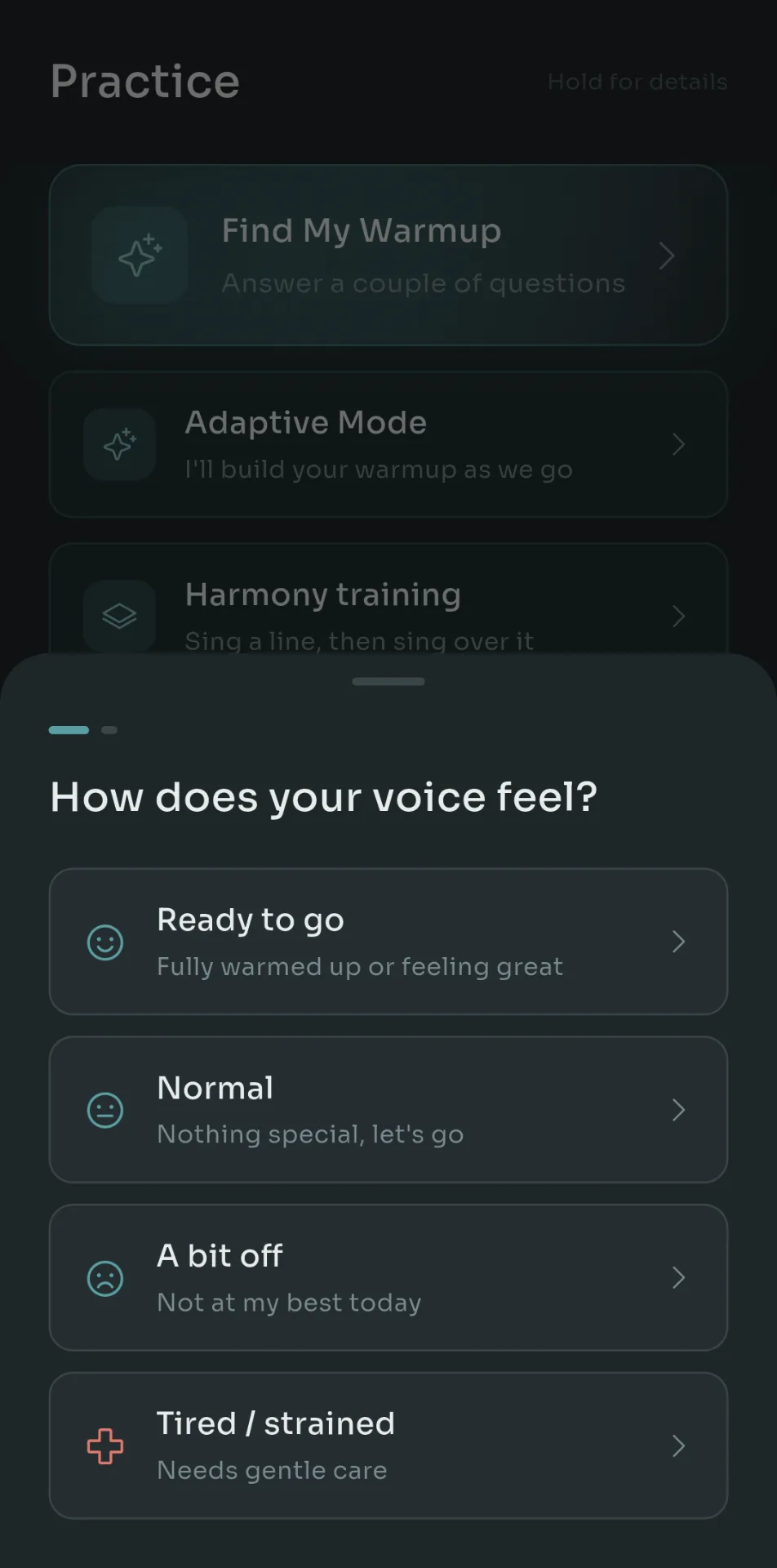
Scalita's Find My Warmup asking how your voice feels, with four options: ready to go, normal, a bit off, and tired or strained
On a day like today you would tap A bit off or Tired / strained. The app then builds a full warmup on the spot around that answer: semi-occluded starts, slower tempo, a range that stays close to the middle, and a shorter total time. Pick Ready to go tomorrow and you get something completely different. Same app, different voice, different routine.
Two small things make a big difference once you are inside the routine. First, there is a breathing step between every exercise, with a countdown so you actually take it instead of rushing on. Second, every step shows the syllable you are singing and a short technique cue. You can see in the screen below that while you are still breathing, it already tells you the next exercise is "Nay" and how to place it. No guessing, no scrambling to remember what your teacher said about forward placement.
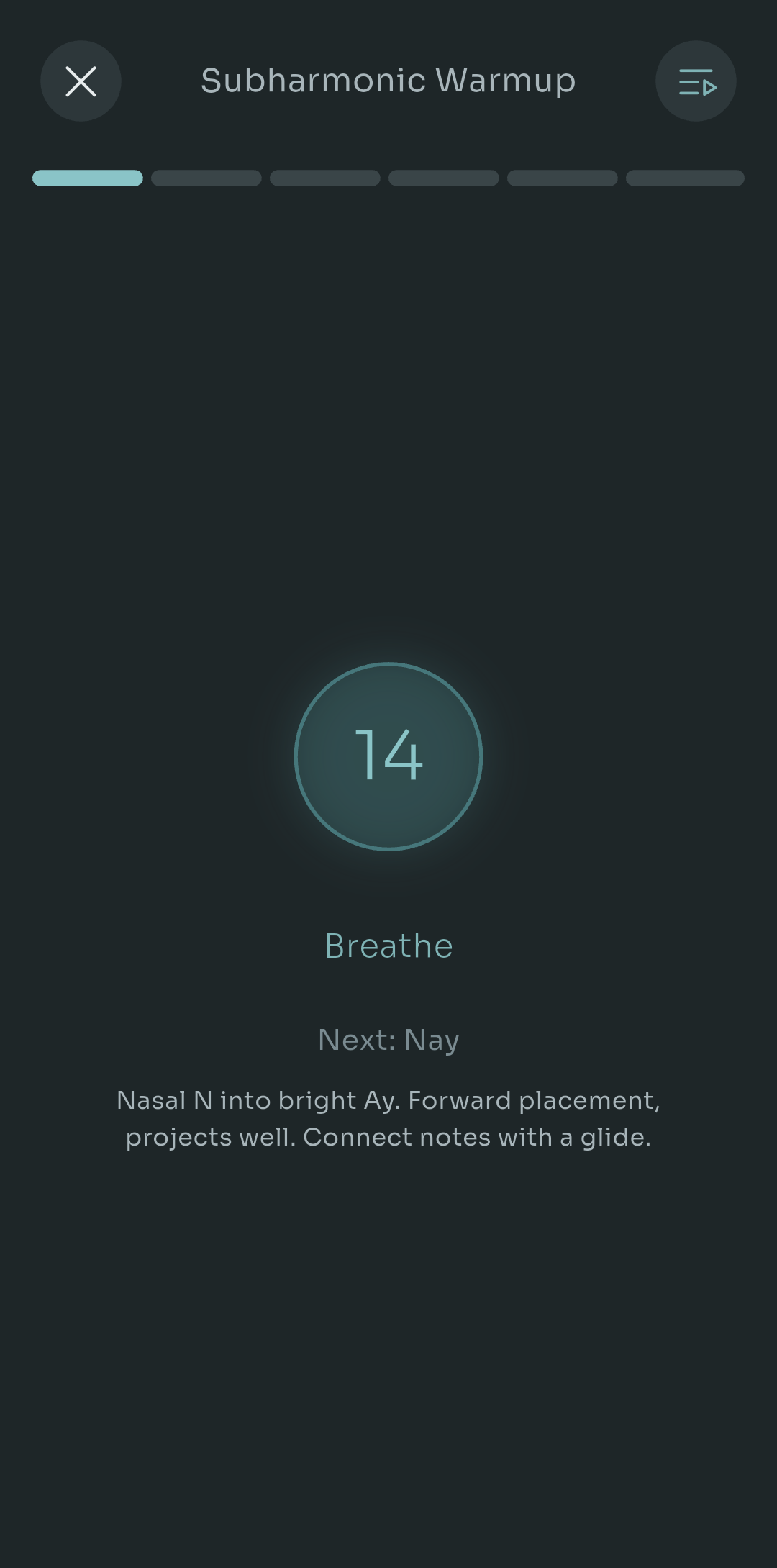
A breathing countdown between exercises in Scalita, showing the next exercise Nay with its technique cue about nasal N into bright Ay
Adaptive Mode: no plan, just feedback
Find My Warmup is great when you know roughly how you feel. Adaptive Mode is for the days when you honestly do not know until you start making sound. It has no fixed plan at all. You do one exercise, then tell it good, meh or hard, and the next exercise adjusts based on that answer. Sail through a hum and it nudges the range a little wider. Struggle with a slide and it backs off, slows down, or swaps to something with more support.
It also asks whether you notice anything specific. This is the question a good teacher would ask in the room, and the options map to the things tired singers actually feel:
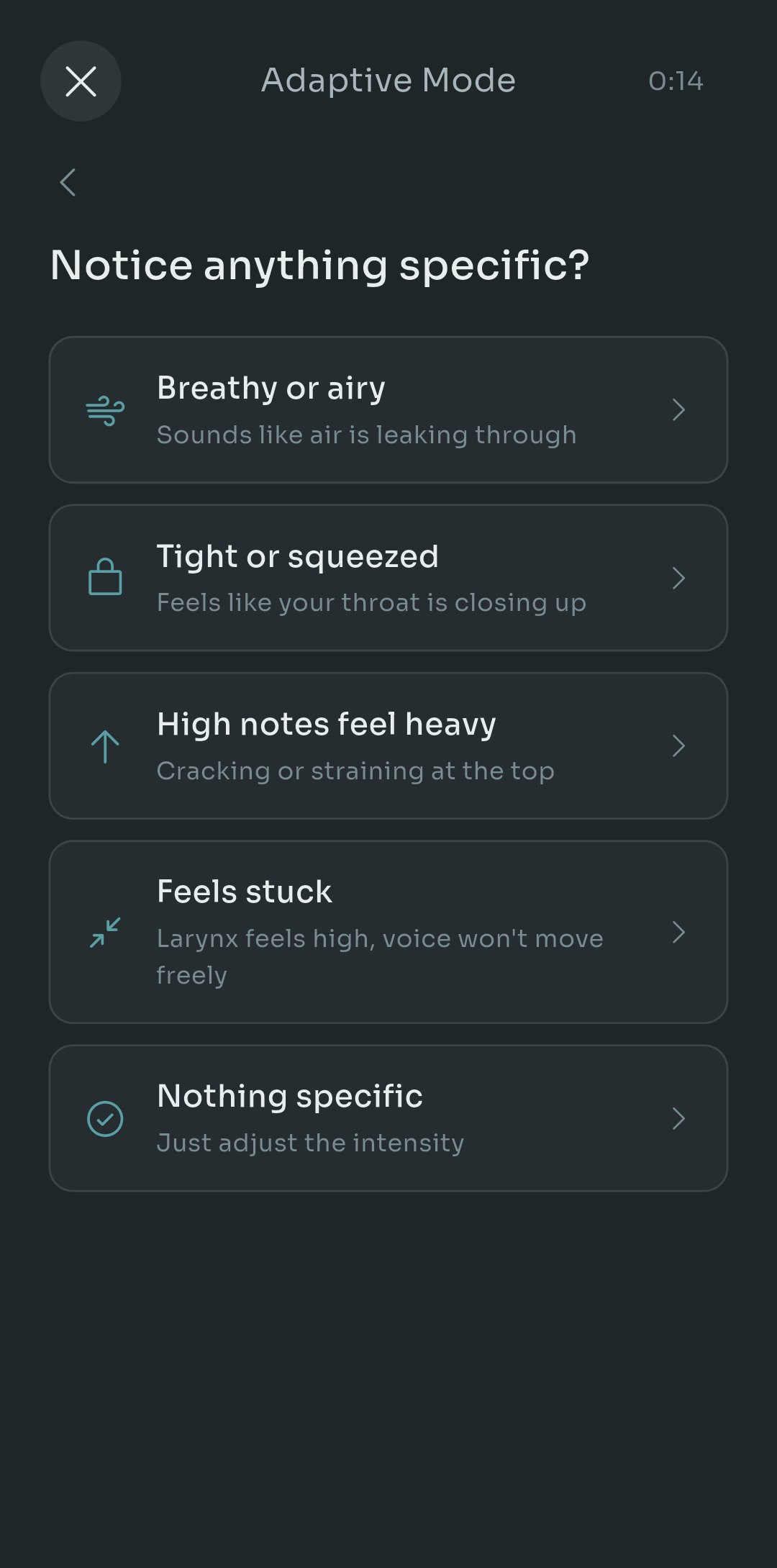
Scalita's Adaptive Mode asking if you notice anything specific: breathy or airy, tight or squeezed, high notes feel heavy, feels stuck, or nothing specific
Tap Tight or squeezed and you get exercises that encourage release and a lower larynx. Tap Breathy or airy and it leans into gentle onset work so the folds close cleanly without pressing. High notes feel heavy tells it to stay low and leave the top alone. Feels stuck brings in the loosening, sliding material. And if you genuinely cannot name it, Nothing specific just adjusts intensity.
One more feature that matters on show days: you can tell it how long you have. Say ten minutes and it paces the whole session to fit, and still saves the last minute or two for a cooldown, which is the step everyone skips when they are rushing to the stage. Ending on a soft, descending hum instead of your loudest exercise is a small habit that pays off tomorrow morning.
When you finish, the summary shows what you actually did: how many exercises, how long, and the range you covered. In the example below that range is deliberately narrow, which is exactly what you want on a tired day. If the first pass felt easy, Again runs it a second time. If it felt like enough, tap Done and go get some water.
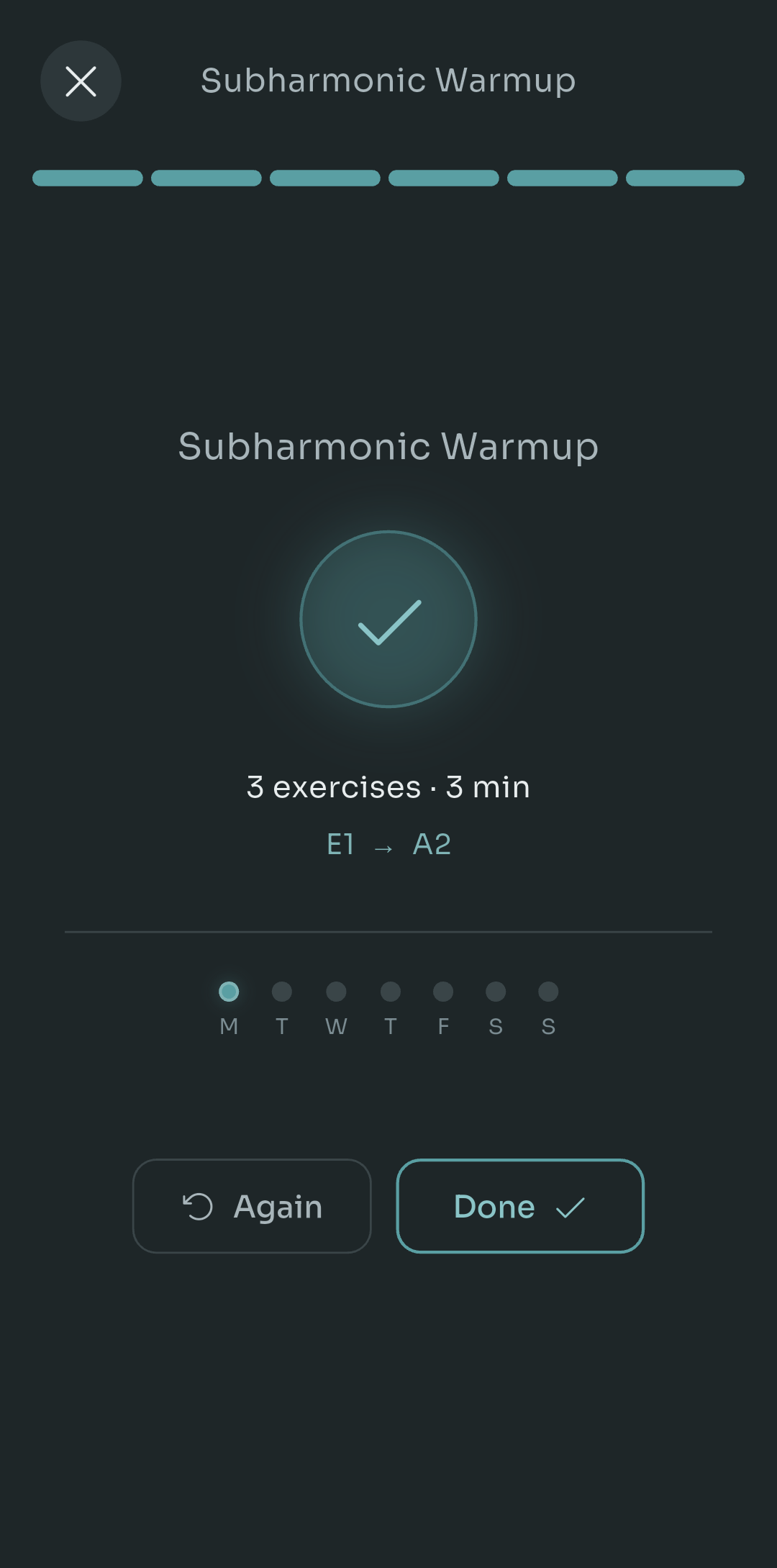
Scalita's end of routine screen showing three exercises in three minutes across a narrow range, with Again and Done buttons
The tired-voice checklist
Screenshot this or scribble it on the back of your setlist. It works with the app, with a piano, or with nothing but a quiet corner.
- Triage first. Pain or post-cold hoarseness means rest, not exercises. No exceptions tonight.
- Hydrate early. Water now helps in two hours, not in two minutes. Steam or a warm drink helps the surface feel better right away.
- Start silent. Two minutes of slow breathing, low and wide, shoulders down. Let the jaw hang.
- Semi-occluded sounds: lip trills or gentle hums on one comfortable pitch, then small slides. Three to four minutes.
- Stay in the middle. Speaking range plus a few notes either side. Do not test the top.
- Halve your usual tempo. If it feels boring, it is probably right.
- Breathe between every exercise. Ten to fifteen seconds, no talking.
- Check in after each one: good, meh or hard. If hard, repeat something easier or stop.
- Cap the session. Ten to twelve minutes, then stop even if you feel you could do more.
- Cool down. Finish on soft descending hums or sighs, never on your loudest sound.
- Protect the voice until stage time. Minimal talking, no shouting over the band during soundcheck, mark the high passages in rehearsal.
- After the gig: another two minutes of gentle humming and then silence. Tomorrow's voice is being decided tonight.
Getting through tonight
A tired voice does not need a heroic warmup. It needs a short, slow, honest one that stays where it is comfortable and stops before it is tired again. Whether you build that by hand from the checklist or let Scalita build it for you, the principle is the same: match the routine to the voice you have today, not the voice you had last week.
If you want to try the app route, Scalita is Android only right now, free to use, with a one-time Pro upgrade for $4.99 (no subscription). It is available in five languages, so the technique cues read naturally wherever you are singing tonight.
Go easy on yourself. Mark the hard bits, sing the rest with intention, and remember that a slightly smaller performance from a healthy voice beats a big one that costs you the next three gigs. Break a leg.

Pablo Dominguez
Full Stack Developer passionate about building interesting projects and learning new skills.