
Three weeks. Twenty-one days between today and the moment you walk out with nothing in your hands. Here's the direct answer: split the time into three phases. Week one, learn the piece in performance order, one section at a time. Week two, review on a spaced schedule, with any line you fumble coming back the next day. Week three, run the whole thing with no help, keep a short daily drill going, and treat the final three days as maintenance, not cramming. Do that honestly and every line is there on the night.
If you'd rather have something run that schedule for you, ReciteFlow is an Android app (Android only for now, iOS is on the roadmap with no date) where you set the performance date on a set and the algorithm compresses the review intervals to fit. The free version covers up to 3 sets with everything included, Pro is $4.99 once, and the interface is in English and Spanish. But the plan comes first, because the plan is what does the work. The app just keeps you honest about it.
I perform, so I've done the panicked version of this more than once. Reading the lyrics off my phone until midnight, feeling fine, then losing the second verse on stage. Sounds familiar? What follows is what I do now instead.
Why you work backwards from the date
The default approach is to start at the top, read the piece through, repeat until it feels okay, and hope it holds. The problem is that feels okay and can recall it cold are two different things. Reading a line while looking at it produces a sense of fluency that has very little to do with whether you can produce that line from nothing, under lights, with your heart rate up.
Two ideas fix this, and both are well established. The first is spaced repetition: you retrieve a line from memory, and if it comes out cleanly you wait longer before the next test. Solid lines stretch out to every few days. Shaky lines come back tomorrow. You spend your minutes where the risk is.
The second is sequential learning. In a song, a script or a speech, the cue for a line is the line before it. That's how you'll retrieve it on stage. So you practise it that way: previous line as the prompt, next line as the answer. Shuffled flashcards break the chain you're trying to build. (This is where generic flashcard apps and randomized decks fall down for performers: they test lines in isolation, and isolation is not how you'll need them.)
Working backwards from the date simply means deciding today how many review passes each line gets before the show, and making sure the weak ones get more of them. With 21 days you have plenty of room. You just can't spend the first 14 pretending.
The three weeks, one job each
Week one: learn it in order
The only goal this week is to get every line into the system once, in the order you'll perform it. Break the piece into its natural sections (verses, choruses, scenes, paragraphs) and add roughly one section a day. Each session starts by reviewing what you learned yesterday, then adds new material.
Rate yourself honestly. A line you had to peek at is not known, no matter how close you were. A repeated chorus only needs learning once, but you still test it at every spot it appears, because the way into the chorus is different each time. By day 7 you should be able to get through the whole piece with the text in front of you, with most lines arriving before you read them.
Week two: spaced review, weak lines every day
No new material. This week you only review what's due. A line you nailed on day 8 might not come back until day 11. A line you fumbled on day 8 comes back on day 9, and on day 10 if it's still rough. By the end of the week your solid lines are on 3 to 5 day gaps and your weak lines have been seen almost daily.
Quick tip: say the lines out loud, standing up, at roughly performance pace. Mumbling them on the couch tests a different skill than the one you'll use.
Week three: run-throughs, a short drill, then maintenance
Now you run the whole piece with no help, start to finish, and mark every stumble. Each stumble goes onto tomorrow's drill. The drill itself should be short, two or three minutes on the flagged lines, and it happens every day so nothing decays while you focus on the full run.
The last three days are maintenance, not cramming. I get that this feels wrong when you're nervous. But cramming on day 20 means loading your head with everything at once, including the 90 percent you already know, which buries the signal from the lines that actually need attention. Sleep does more for recall at that point than another hour of reading. Do the drill, do one relaxed run, stop.
A line you fumble on day 18 needs to be seen again on day 19, not on the day of the show.- Pablo Domínguez
Here's why that matters. If you fumble on day 18 and next test it on the day of the show, that line gets exactly one retrieval attempt under pressure, with no chance to fix it if it fails. If you test it on day 19 and again on day 20, it's been retrieved successfully twice more before you need it, each time a little further from the last. That's the whole mechanism. Retrieval, gap, retrieval. The show should be one more retrieval in a series, not the first real test.
Now, let's talk about the app
ReciteFlow does the scheduling above with what it calls SSRS, a Sequential Spaced Repetition System: lines are learned in performance order, never shuffled, and each line comes back for review on a schedule that stretches as it gets solid. You paste the text, pick a type (lyrics, script, speech, other), and section detection finds the verses, choruses, scenes or paragraphs. A repeated chorus is learned once and tested at each place it occurs.
Then you set the performance date. This is the screen you get right after doing that, with the first line practised and nothing else:
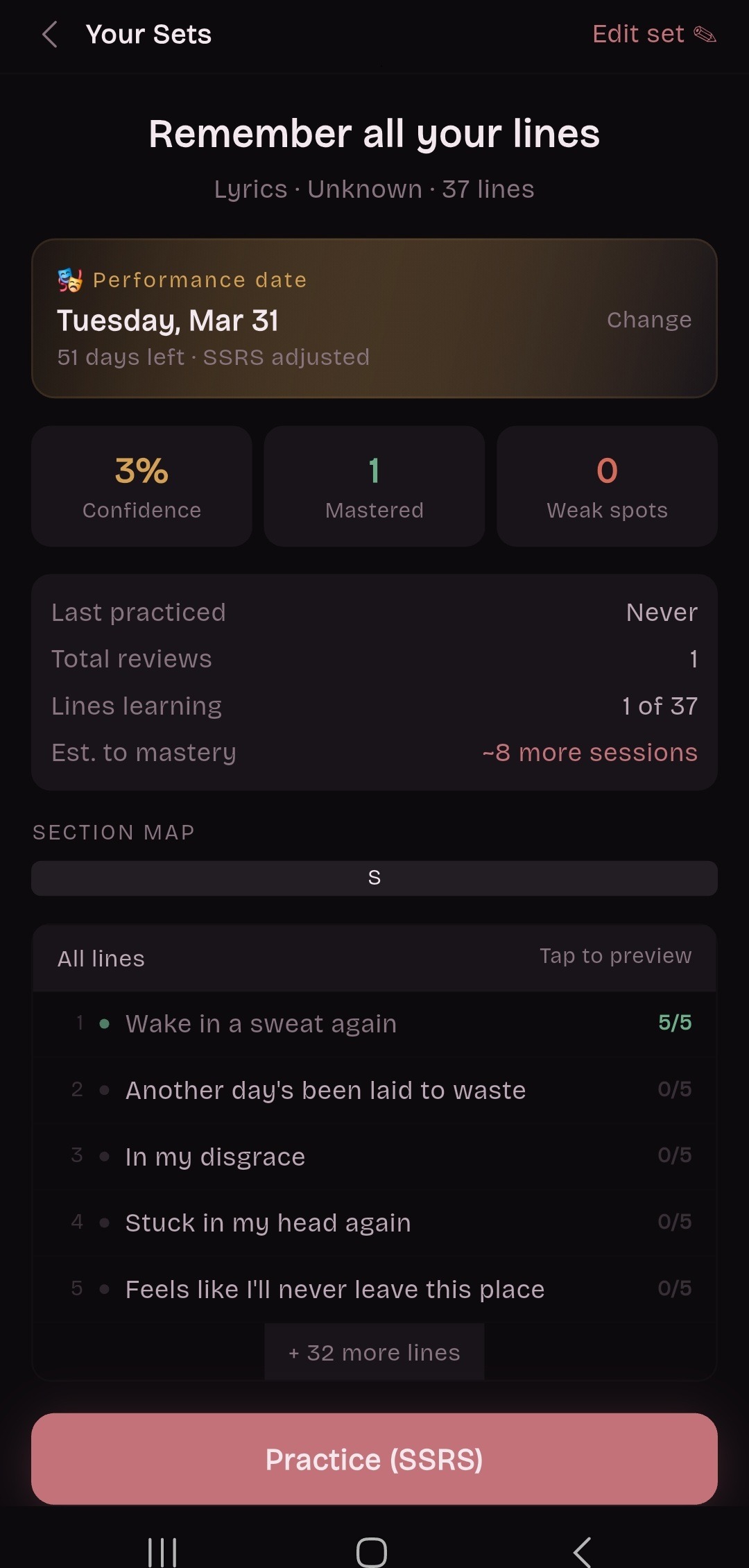
ReciteFlow set details showing a 37-line lyrics set with a performance date 51 days away, SSRS adjusted, 3 percent confidence, 1 line mastered and an estimate of 8 more sessions
A few things worth reading off that screen. The set is 37 lines. The performance date is Tuesday, March 31, 51 days out, and the card says SSRS adjusted, meaning the intervals have been compressed to land everything before that date. Confidence sits at 3 percent, one line is mastered (the first one, rated 5/5), the other 36 are at 0/5, and the estimate is about 8 more sessions to mastery. Day one, honest numbers. That estimate and the confidence figure are what you watch move over the three weeks.
A practice session works the way I described: a card shows the previous line and asks for the next one. You say it, tap to reveal, and rate yourself Blank, Shaky, Close, Solid or Instant. The rating decides when that line comes back. As the date approaches, the weakest lines get pulled back sooner. Pro adds hint modes (first letter, fill the gap, full blind) if you want to tighten the screws in week two.
Then there's the part that replaces willpower. A couple of weeks in, the home screen looks like this:
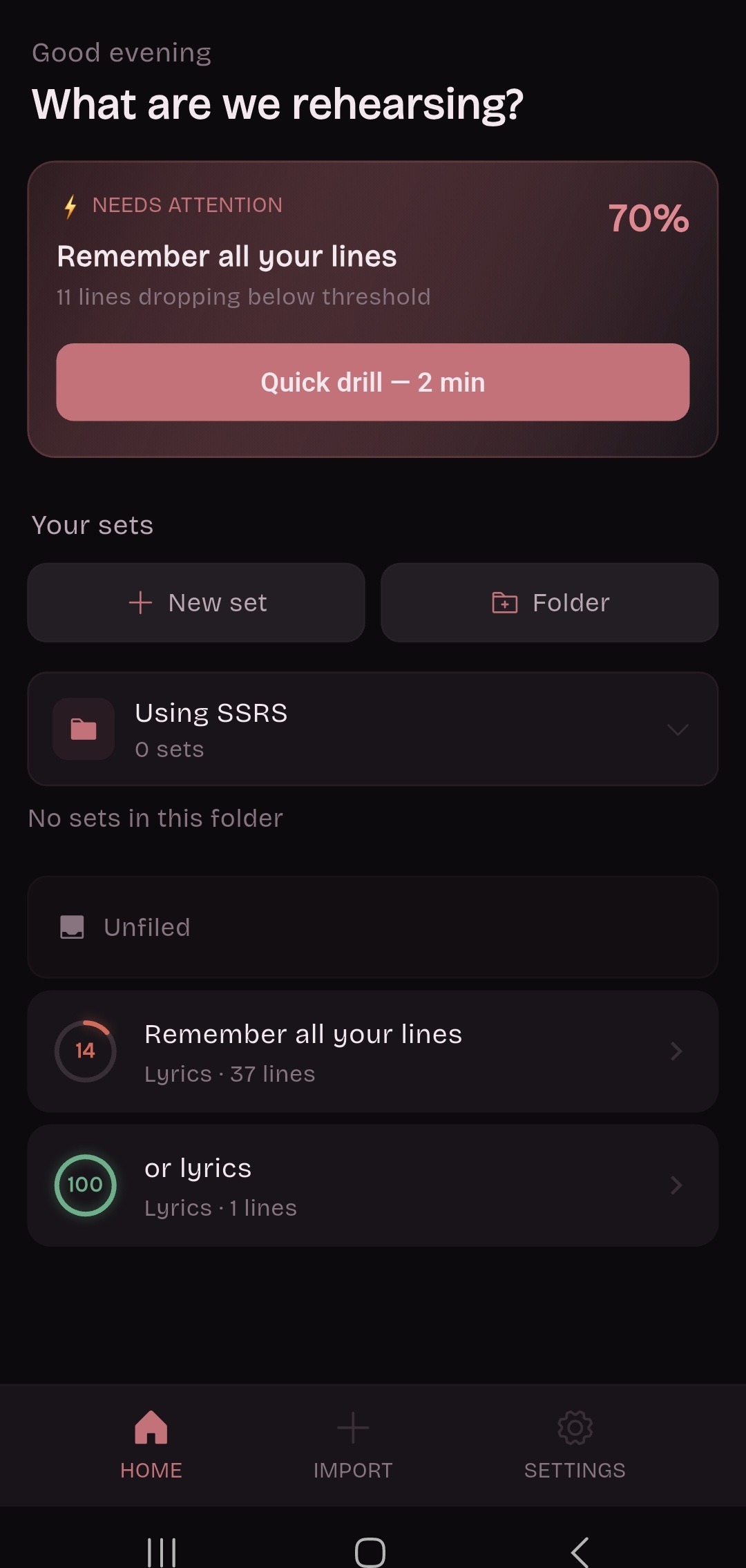
ReciteFlow home screen with a Needs Attention card showing the set at 70 percent, 11 lines dropping below threshold, and a quick drill button of about 2 minutes
The set is at 70 percent, but the card at the top flags 11 lines dropping below threshold and offers a quick drill of about 2 minutes. That's the day-18-to-day-19 rule made visible. You don't have to remember which lines were shaky yesterday; you open the app, it tells you, you do two minutes, and those lines are back on schedule. For the final week, run-through mode takes you through the entire piece start to finish, and every line in the set details keeps its own score so you can see exactly where the stumbles are.
Everything stays on the device: no account, no tracking, works offline in a rehearsal room with no signal. If you're in a band or a cast, a set exports as a .reciteflow file, with or without your progress, so one person pastes the text and everyone imports it. More detail at reciteflow.com.
The 21-day plan, day by day
Here's the whole thing laid out. Sessions in week one run 5 to 10 minutes. Week two is usually shorter. Week three is a full run plus a couple of minutes of drill. If you're using ReciteFlow, the daily instruction is mostly "open it and do what's due," but the shape is the same either way.
- Day 1: Paste in the text, set the performance date, do the first session on the opening section. Most lines will rate Blank or Shaky. That's correct.
- Day 2: Review yesterday's lines first, then add the next section.
- Day 3: Review everything so far, add the next section.
- Day 4: Review, add. If the piece has a repeated chorus, notice it only needs learning once.
- Day 5: Review, add. Write down any line that has been Shaky three days running.
- Day 6: Review, add the final section.
- Day 7: One pass through the entire piece with the text visible. Everything is now in the system.
- Day 8: Review only what's due. No new material. The weak lines from week one come back today.
- Day 9: Due reviews, out loud, standing up.
- Day 10: Due reviews. Solid lines start stretching to 3 or 4 day gaps.
- Day 11: Due reviews. Check the weak spot count. It should be lower than day 8.
- Day 12: Due reviews, plus one slow read of the full piece to hear the transitions between sections.
- Day 13: Due reviews. Anything still Shaky gets a second look in the evening.
- Day 14: First full run-through with no help. Mark every stumble.
- Day 15: Two-minute drill on yesterday's stumbles, then a second run-through.
- Day 16: Short drill, run-through at performance pace.
- Day 17: Short drill, run-through with a distraction (music on, someone in the room).
- Day 18: Short drill, run-through. Any fumble goes on tomorrow's list, not the show's.
- Day 19: Maintenance. Two-minute drill on flagged lines, one relaxed run-through.
- Day 20: Maintenance. Drill, one run-through, stop. Sleep.
- Day 21: Show day. A two-minute drill on the flagged lines in the afternoon, nothing else. You already know it.
Notice what's not in there: no all-nighters, no reading the whole piece twenty times on day 20. The heavy lifting happened in weeks one and two. Week three is about trusting the schedule.
Questions people also ask
Can I really memorize a full script or set list in three weeks from zero?
Yes, if you spread it out. A 37-line song fits comfortably; a longer script just means more sections per day in week one and possibly starting review a day or two earlier. The plan scales, the phases don't change.
Should I memorize lines in order or mix them up?
In order. On stage, the cue for each line is the line before it, so that's the connection you need to build. Shuffling tests lines in isolation, which is not how you'll retrieve them.
How many times a day should I practise my lines?
Once is enough if you do it every day. A single honest session with self-rating beats three passive read-throughs. In the final week, add a short drill of two or three minutes on flagged lines.
What if I still forget a line the day before the show?
Drill that line and its cue (the line before it) a few times on day 20 and once more on day 21. Don't reopen the whole piece. One weak line is a targeted fix, not a reason to cram.
Is ReciteFlow on iPhone, and what does it cost?
It's Android only right now, with iOS on the roadmap and no date yet. The free version has the full SSRS, performance deadlines, section detection and share and export for up to 3 sets. Pro is $4.99 one time for unlimited sets, hint modes, folders and a light theme. Interface in English and Spanish.
If you've got a date on the calendar right now, start today with day 1, and let me know in the comments how the weak spot count moves by day 11. Know every line. Own the stage.

Pablo Dominguez
Full Stack Developer passionate about building interesting projects and learning new skills.