
You're sitting in the car. The venue is right there. You've got about ten minutes before you need to be inside, and your voice feels like it woke up five minutes ago. Sounds familiar?
Here's the short answer, because you don't have time for a long one: ten minutes is enough. Not enough for a full technical session, but enough to walk on stage with a voice that responds. The catch is that it only works if the order is right. Most people waste short warmups by doing the wrong thing first (usually belting the chorus of the opener), and then wonder why the first two songs feel stiff.
So here's the order. Read it once, then put the phone down and start.
The Ten Minute Order
- Minutes 1 to 2: hums and lip trills, sitting in the middle of your range, nothing high, nothing low
- Minutes 3 to 5: five-note patterns climbing gently, one step at a time, stopping well before the top
- Minutes 6 to 7: the vowel and the range you need for the first song, and only the first song
- Minutes 8 to 9: something sustained, long notes on a comfortable pitch, steady air
- Minute 10: an easy descending pattern to settle everything back down
That's it. Five steps, ten minutes, and you're ready. If you only remember one thing from this post, remember the sequence: hum, climb, target, sustain, settle.
Now, let's talk about the one rule that makes or breaks this.
The One Rule: Don't Touch the Top
In a short warmup, never go to the top of your range. Not once. Not "just to check it's there."
I get that this feels wrong. If the set has a big note in song three, surely you want to know it's working before you walk out? But here's the trick: the top of your range is the most expensive part of your voice to reach when cold, and the show is going to take you there anyway. Your job in the car park is to get the engine turning over, not to redline it in the driveway.
Think of it like a footballer warming up. They jog, they stretch, they pass the ball around. They don't sprint the full length of the pitch at match pace before kick-off. The match does that. Your first song does that.
A short warmup should end with your voice wanting more, not having already given its best note to an empty car park.
If you go to the top cold and it cracks, you've now got ten minutes of anxiety instead of ten minutes of preparation. If it doesn't crack, you've spent your freshest attempt on nobody. Either way, you lose.
Why This Order and Not Another
Each step does a specific job, and the jobs stack. Skip one or shuffle them and the whole thing gets less useful.
Hums and lip trills first because they get the folds vibrating with almost no pressure. The lips take the load, the voice just follows. Two minutes here and the "morning voice" fog starts lifting. Stay in the comfortable middle. If you're driving with the windows up, nobody can hear you anyway.
Five-note patterns next because now you're asking the voice to move, but only a little. Think a simple do-re-mi-fa-sol and back, then up a half step, then again. Three minutes of this covers a decent chunk of range without ever forcing anything. The word that matters here is gently. If a step feels like effort, don't take the next one.
The first song's vowel and range is the step most people skip, and it's the one that makes the biggest difference to how the opener feels. If your first song lives on an open "ah" around the middle of your voice, spend two minutes there. If it sits on a closed "ee" a bit higher, go there instead (still not the top, remember). You're rehearsing the exact coordination you'll need in three minutes' time.
Sustained notes settle the air. After all that movement, two minutes of long, steady tones on a comfortable pitch reminds your breath to stay even. This is where you notice whether you're rushing, and you fix it before an audience does.
The descending minute is the cooldown before the show. Sounds odd to cool down before you've started, but a short descending slide (a sigh on "oo" works) releases any tension the climbing built up. You walk in loose instead of primed.
Quick tip: if you've only got six minutes, don't drop steps. Shrink them. One minute of hums, two of patterns, one on the first song, one sustained, one descending. The shape matters more than the length.
The App Version of the Same Answer
I built Scalita because I kept doing this exact warmup in car parks and kept getting it slightly wrong. I'd rush the hums, or I'd climb too far because I lost track of where I was, or I'd forget which vowel the opener needed. So the app has a routine called Pre-Performance Quick, and it's this post in playable form: five steps, about thirteen minutes at a relaxed pace, faster if you tap through.
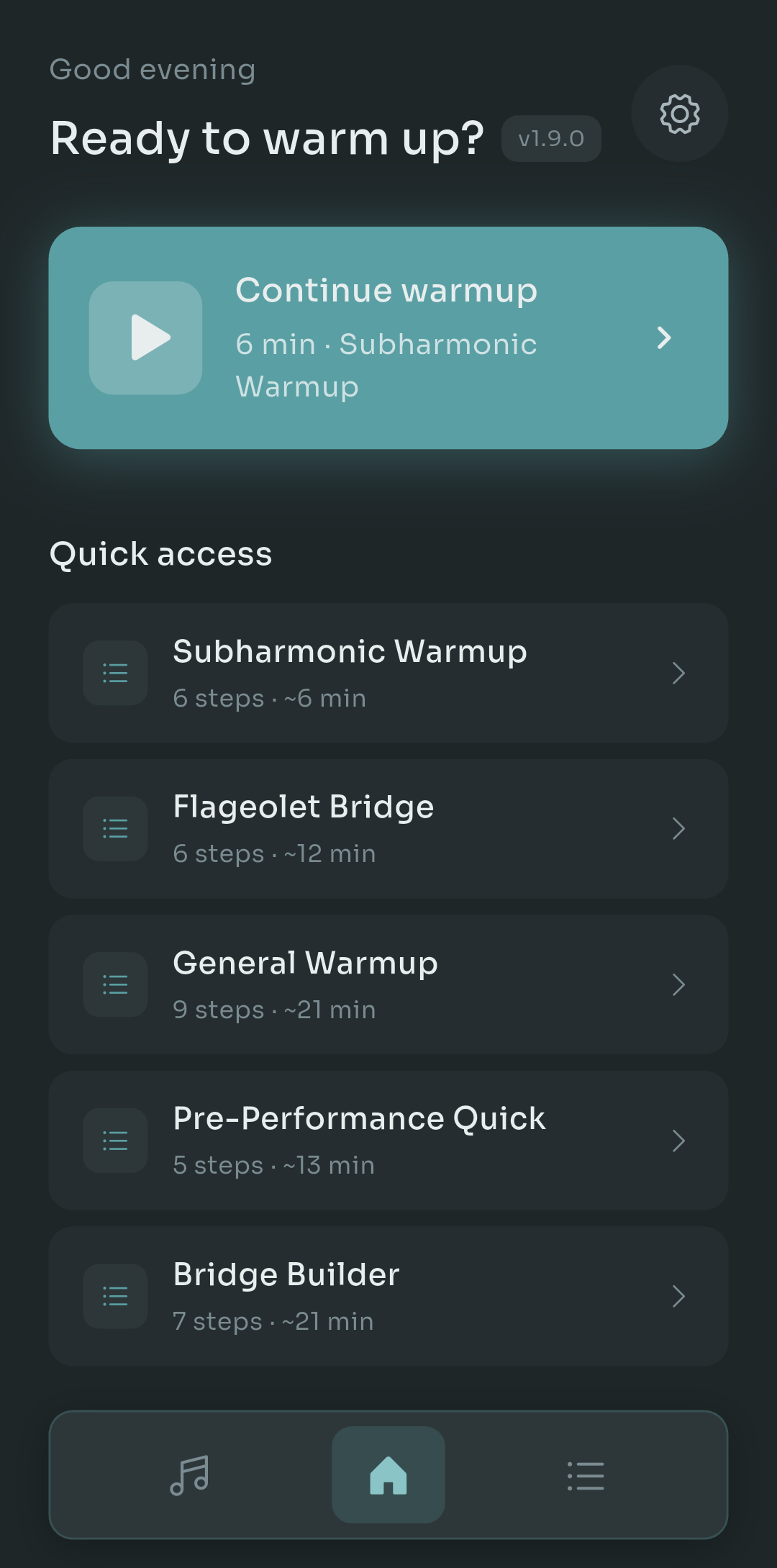
Scalita home screen showing the Quick access list, with Pre-Performance Quick at five steps and around thirteen minutes
It sits right there in Quick access on the home screen, fourth in the list. Everything is transposed to your range, so a baritone and a soprano tapping the same routine hear different notes. The piano is a real sampled piano, not a synth beep, which matters more than you'd think when you're trying to match pitch in a noisy car. Put your earphones in and the pitch monitor shows you whether you're actually landing the note or just near it. You can turn it off if it stresses you out. Some nights it does.
Now, what if you don't even have ten minutes? This happens more than anyone admits. Soundcheck ran long, the choir director is already calling people in, the karaoke host just skipped two names.
That's what Adaptive Mode is for. You tell it how long you've got, ten minutes or six or whatever the honest number is, and it paces the entire session to fit, cooldown included. Then between exercises it asks you a simple question about how that one felt.
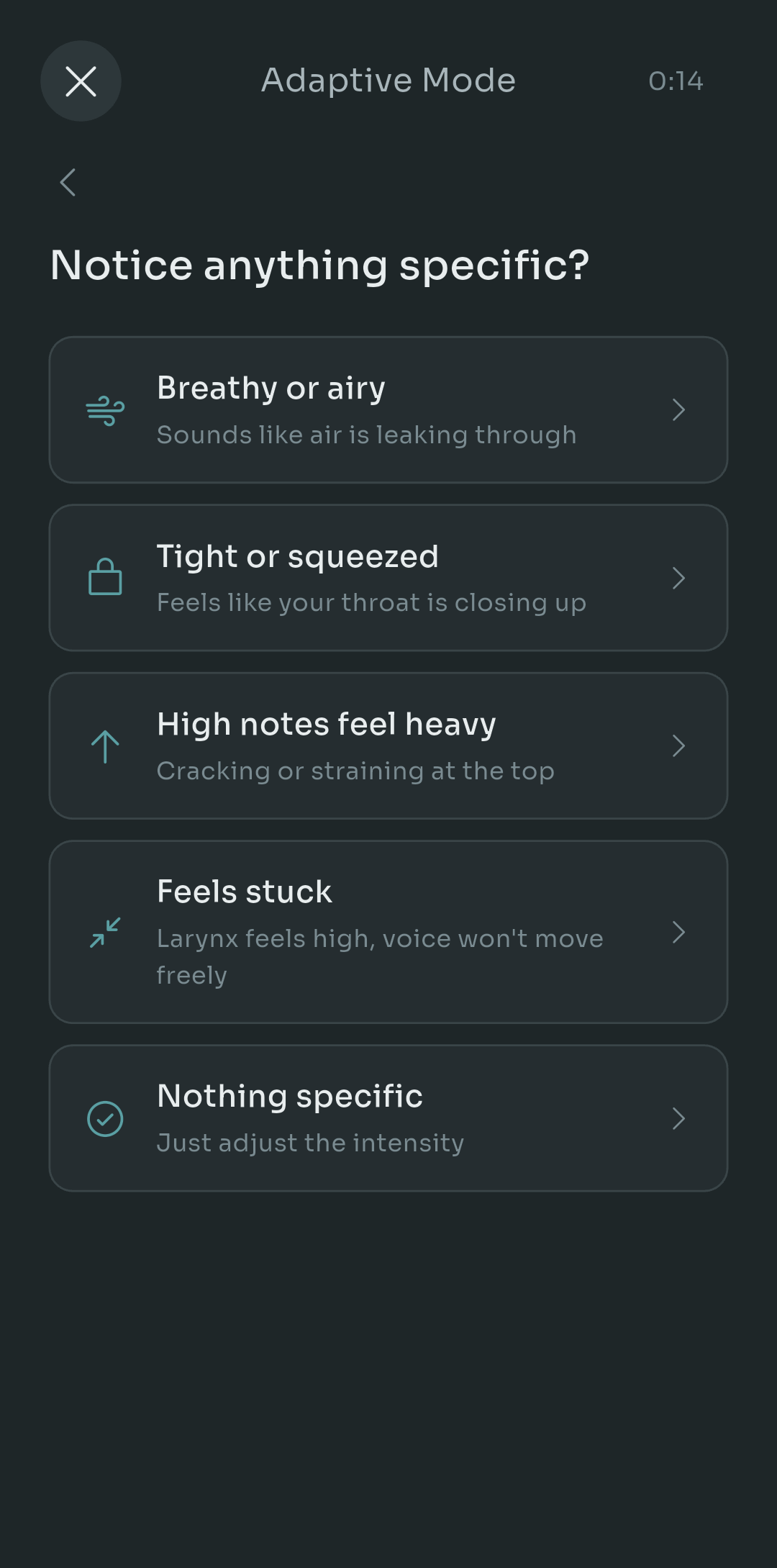
Scalita Adaptive Mode screen with the timer running, asking whether the voice feels breathy, tight, heavy at the top, stuck, or nothing specific
Breathy? It leans into exercises that firm up the closure. Tight or squeezed? It backs off and gives you release work. High notes feel heavy? It stays lower for longer, which is exactly what the one rule says you should do anyway. Nothing specific? It just adjusts the intensity and keeps going. The timer at the top keeps counting, so the session actually finishes when you said it would, not two minutes after you needed to be on stage.
And when you're done, you see this.
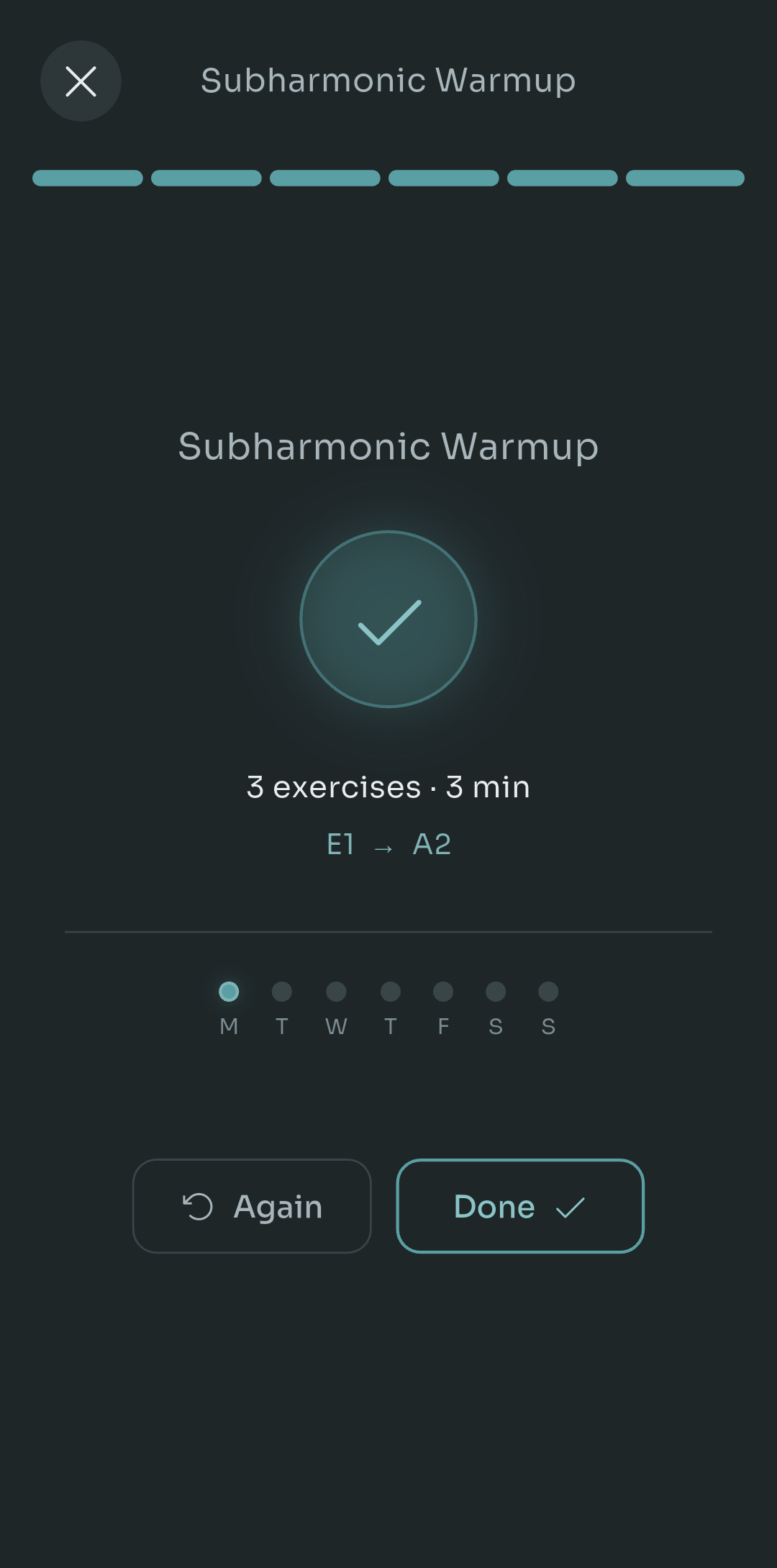
Scalita completion screen showing three exercises finished in three minutes, with the range covered and a weekly streak tracker
Three exercises, three minutes, and it shows you the range you covered. That one was a very short session (I had a train to catch), but it counted. The weekly dots fill in either way, and honestly that little row of dots has done more for my consistency than any amount of good intentions.
Two practical things for the backstage crowd. First, it works offline. No signal in the green room, no signal in the underground car park, doesn't matter. Second, there's no account. Nothing to log into with cold hands, no password reset email you can't receive because, again, no signal.
I get that you might be thinking "another subscription." It isn't one. Scalita is Android only for now, free to use, and Pro is $4.99 once. Not per month. Once. It runs in five languages, so if English isn't your first one, the exercise instructions probably aren't either.
What to Do Right Now
If you're reading this in the car park, you've already used up about two of your ten minutes. Here's the plan.
- Start humming now, middle of your range, while you finish reading
- Move to lip trills, then gentle five-note patterns, stopping well before the top
- Spend two minutes on the exact vowel and pitch area of your first song
- Hold a few long notes, then slide down on an "oo" to settle
- Walk in with something left in the tank
If you'd rather not count minutes in your head, install Scalita before the next gig, open Pre-Performance Quick, and let it do the counting. Or tell Adaptive Mode how long you've actually got and be honest about the number.
Either way, the principle is the same: short warmups work when they're ordered right and stop before the top. The show will take you there. Your job is to arrive ready for it.
Got a car park routine of your own that works? I'd genuinely like to hear it. Drop it in the comments, especially if it's shorter than mine.

Pablo Dominguez
Full Stack Developer passionate about building interesting projects and learning new skills.